
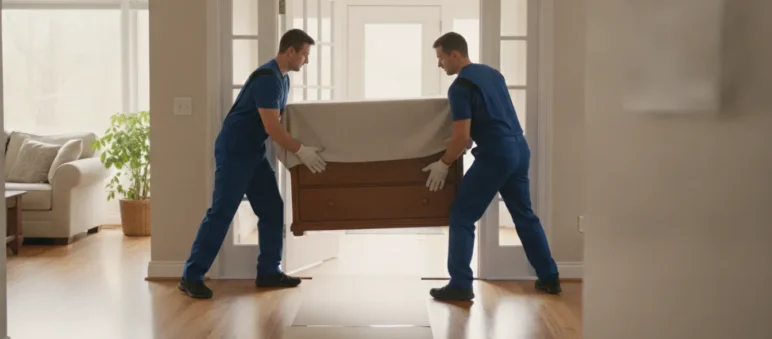
Heavy furniture can be difficult to control before it feels too heavy to lift. Its shape, handholds, and route all matter. A sofa may clear a doorway straight on but fail to make the turn at a landing. A dresser can also shift if drawers move. Before anyone lifts, inspect the piece and walk the full route, including thresholds and stairs.
Request a moving estimate for your household’s heavy items
The safest way to approach how to move heavy furniture is to plan the route. Check the item’s size and handholds, clear obstacles, and protect floors and doorframes before deciding who should handle it.
That first assessment does not prove a household lift is safe. The NIH moving guide recommends testing an item’s weight first and asking for help if it is too heavy. The guide covers workplace moves. Treat it as practical advice, not a residential weight limit or safety guarantee. Consider awkwardness, grip, and every turn or step on the route.
How Do You Plan How to Move Heavy Furniture Safely?
Start by judging more than the item’s apparent weight: consider its shape, balance, handholds, route, and who can help. Clear the entire path and identify stairs, tight turns, and uneven surfaces before handling anything. If the piece feels difficult to control, do not attempt a solo lift; pause and arrange suitable help.
Look at the furniture from several sides. A solid wood cabinet, a wide sofa, and a glass-fronted bookcase can be difficult for different reasons. Consider whether the item is top-heavy, has doors or drawers that could shift, or has a shape that blocks your view. Check for sturdy places to grip. Smooth surfaces, loose handles, and narrow edges can make it harder to keep the item close and under control. Notice whether doors, shelves, or removable parts could swing or shift, and whether the item can be held without blocking the helpers’ view. Do not treat an uncertain grip as a problem that straps or determination will automatically solve.
OSHA lists load weight, awkward posture, poor handholds, and environmental conditions as material-handling risk factors. Its workplace guidance is not a residential lifting certification or safety guarantee. Assess the whole move instead of relying on one weight number. Review OSHA’s material-handling guidance for its workplace context.
Walk the route from the item’s current location to its destination. Check whether people can pass without stepping around obstacles, whether the floor is slippery or cluttered, and whether the furniture can turn without striking walls or door frames. A clear route matters even when using a cart, because equipment still needs room to move and stop. Do not assume a staircase is suitable for a heavy item simply because it fits.
Think honestly about the helpers, not just their number. Anyone assisting should understand the plan, have a secure grip, and be able to follow coordinated directions. NIH’s moving guide recommends testing an item’s weight first, asking for help when it is too heavy, and choosing one person to coordinate a group lift. These are planning cues, not proof that a particular team can manage a specific piece. NIH’s moving guide is written for a laboratory setting, so adapt its advice cautiously.
Before proceeding, agree on who gives directions and where the item will pause if anyone needs to stop. Move only when the load is manageable, the route is clear, and the group can stay coordinated. NIH also advises pivoting with the feet instead of twisting. If balance, grip, visibility, or control becomes uncertain, set the plan aside and seek professional assistance rather than improvising.
What Should You Measure Before Moving a Heavy Piece?
Measure the furniture and the full route before anyone tries to move it. Check doorways, hallways, turns, landings, stairs, and elevators, including the tightest points. Then clear the path and compare the available space with the piece’s dimensions. If it will not pass safely, stop and get help rather than forcing it.
Start with the item’s height, width, and depth. Include parts that stick out, such as handles or feet, unless they can be safely removed. Note whether cushions, shelves, or other removable components change the overall size. Measurements are useful only when they reflect the furniture as it will actually be moved.
Next, measure the route from its current location to the destination. Check the clear opening of each doorway, not just the door itself. Measure hallway width and length, and note any sharp turn where the piece would need to change direction. Check both the approach and exit at each turn.
For stairs, landings, and elevators, record the usable width and height, as well as space to enter and exit. A piece that fits through a doorway may still be too large to turn in a hallway or position on a landing. Do not treat a measurement as proof that a difficult stair move is safe.
Walk the entire route before moving day. Look for rugs, boxes, cords, open doors, and other obstacles, then arrange to clear them. Make sure the path and destination are accessible, and share any narrow points or access limits with the people helping. This guide to clearing a safe path for movers covers other useful preparation.
A simple checklist can keep the assessment organized:
- Record the furniture’s widest, tallest, and deepest dimensions.
- Measure each doorway, hallway section, turn, landing, stair passage, and elevator opening.
- Note obstacles, low ceilings, rails, and places where people need room to move.
- Compare the measurements before handling the item, and leave room for a controlled route.
If measurements suggest the piece may scrape, jam, tip, or leave too little room for people to move safely, do not test the fit by pushing or lifting. Stop and contact professional movers to assess the route and the item. A careful walk-through can identify a problem early, before furniture or the home is put at risk.
How Can You Protect Floors, Walls, and Furniture?
Before moving a heavy piece, cover the route and vulnerable surfaces, then protect the item itself. Secure floor runners or suitable coverings so they cannot bunch or slide. Pad exposed corners and wrap finished surfaces as appropriate. Keep the path clear, and do not drag furniture or place sliders beneath a load unless it is safely supported.
Start with the floor from the furniture’s current position to its destination. Use a suitable floor covering, and check that its edges stay flat underfoot. Protect door frames and tight wall corners where the piece may pass close. A clear route also gives helpers room to communicate and maneuver without stepping around boxes or loose cords.
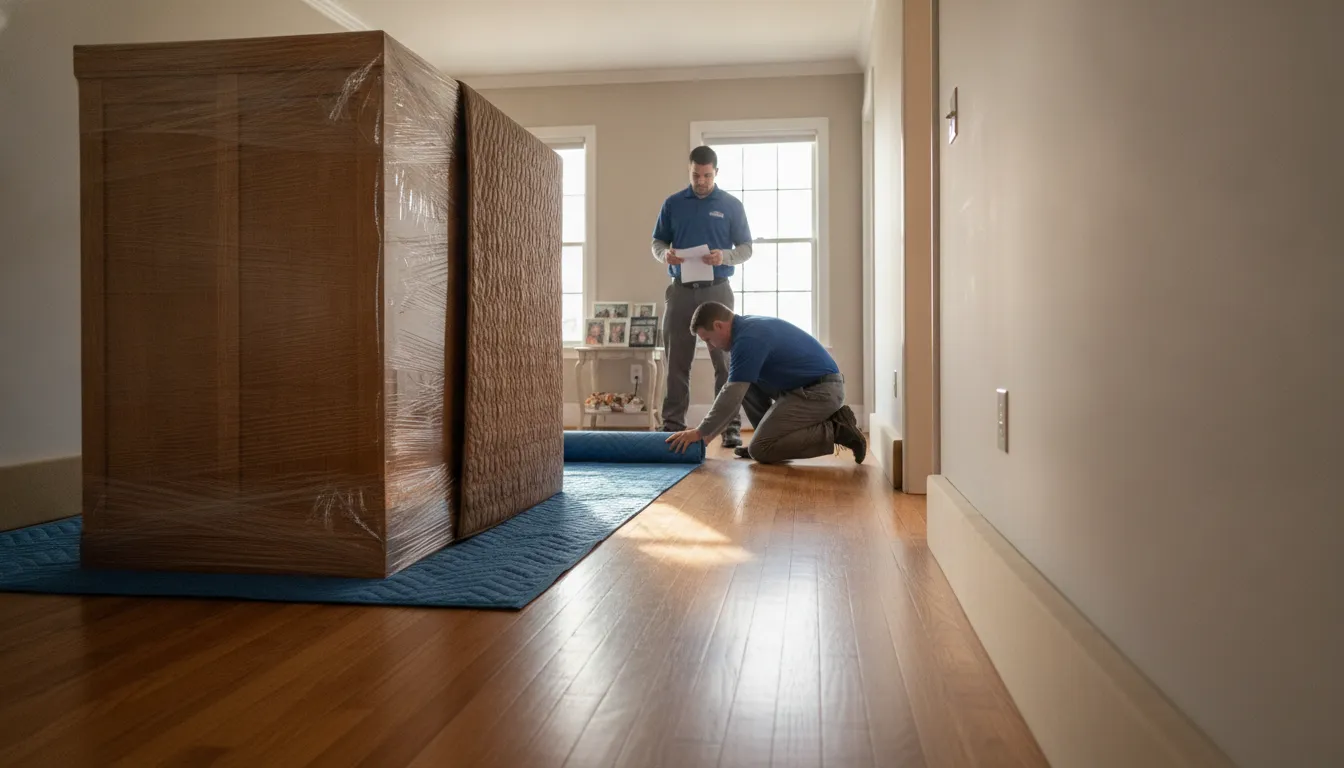
Choose protection suited to the floor material. Avoid tape or coverings that could mark a finish. Walk the route and flatten curled edges before moving. Delaware Moving & Storage describes using furniture and premises protection, including door and floor protection, in local moves.
Wrap furniture to reduce scuffs and shield vulnerable edges. Moving pads can cushion broad surfaces, while stretch wrap can help keep padding in place. Do not wrap delicate finishes directly with a material that might cling or leave residue. Remove loose contents first when practical, and check that the wrapping does not cover a safe handhold.
Never drag a heavy item across the floor. It can scrape the surface or catch on a threshold. Sliders may suit some moves, but only with safe support and adequate help. Do not lift one side to push sliders under a loaded piece if you cannot control it. Stop and arrange assistance.
For more practical advice, read the guide to protecting floors while moving furniture. Delaware Moving & Storage also offers professional packing services in Delaware for full or partial packing.
What Is the Safer Way to Move Heavy Furniture With Help?
Use a capable team, suitable equipment, and a checked route before moving a heavy piece. Agree on commands and stop if the grip, balance, or path feels uncertain. If the item is too awkward to control, do not attempt the move. Get trained help instead.
More people do not automatically make a lift safer. Team members need to be able to hold their positions and move together, while the furniture offers stable handholds. An item with an uneven shape, loose parts, or a slippery surface may be difficult to control even when it does not seem especially heavy. For a manageable piece, test its movement cautiously before committing to a lift, and set it down if anyone cannot maintain a secure hold.
Choose one person to lead with short calls such as “ready,” “lift,” “move,” and “down.” Everyone should know the destination and when to pause. NIH recommends a team coordinator so people lift and lower together. It also advises pivoting with the feet instead of twisting. Keep a neutral back when possible, but posture cannot replace adequate help or equipment. NIH moving safety guidance was written for laboratory moves. Adapt its coordination ideas thoughtfully at home.
For heavy objects, a suitable moving device may reduce carrying by hand. OSHA lists equipment and two-person lifting as workplace controls. That guidance is not a universal household weight rule. Its roughly 50-pound note is not a home-moving cutoff or a guarantee that lighter items are safe to lift. OSHA’s workplace ergonomics controls explain equipment and work practices.
Back strain can follow repeated heavy lifting or a sudden awkward movement, according to Mayo Clinic’s back-pain guidance. Twisting while lifting is also identified as a possible cause of a herniated disk in its herniated-disk overview. Neither source makes a particular lift safe for every person.
Pause if stairs, a tight turn, or a landing leaves no safe place to stop. Arrange professional help before moving the item.
Should You Disassemble Furniture or Hire a Professional?
Removing loose contents and a few simple, maker-approved parts can make a piece easier to prepare. Keep structural work, difficult reassembly, and risky lifting to trained professionals. If furniture is unusually heavy, unstable, valuable, or difficult to handle safely, pause and ask for an assessment before taking it apart.
Start by emptying drawers, shelves, and cabinets so contents cannot shift during handling. If a component is designed to come off easily, and the instructions allow removal, you may prepare it separately. Examples can include removable shelves, cushions, or legs that detach with ordinary fasteners. Do not force a stuck part or guess how a joint is secured.
Place each set of screws, bolts, and small fittings in a sturdy bag, then label it with the piece and the part it belongs to. Secure the bag to the corresponding furniture only if doing so will not damage the finish or interfere with wrapping. Photographing the piece before removing a permitted part can also help you remember how it fits back together.
Stop before removing load-bearing rails, glued joints, built-in mechanisms, or components that affect the furniture’s balance. Structural disassembly can create new hazards, damage the item, or leave a difficult reassembly job. If you are unsure whether a part is intended to be removed, leave it in place and ask the manufacturer or a mover for guidance.
A piano, safe, or oversized and awkward piece deserves a professional assessment rather than an improvised plan. The same is true when stairs, narrow turns, unstable furniture, poor handholds, or a lack of capable helpers make the move uncertain. Delaware Moving & Storage lists pianos, gun safes, heavy machinery, and other specialty items among its specialty moving services. A survey can help identify access constraints and discuss the handling required.
Service scope matters when planning furniture breakdown. Delaware Moving & Storage offers furniture assembly and disassembly for long-distance and interstate moves. That does not establish that disassembly is included on local moves, so confirm what is available for your specific move before relying on it.
If a piece cannot be safely prepared without specialized tools, significant force, or a risky lift, leave it assembled and explain the concern during your estimate discussion. A trained crew can assess the item and route, then clarify whether professional handling is appropriate. Choosing not to dismantle uncertain furniture is often the more practical preparation.
How Do You Plan Loading and Storage for Heavy Pieces?
Professional movers should manage heavy-item loading, equipment selection, and weight distribution; homeowners can help by sharing destination details and deciding where each piece belongs. If delivery timing does not match move-in timing, discuss temporary storage, access arrangements, and the expected delivery window before moving day.
Before the crew arrives, confirm which heavy pieces go to each room. Note stairs, narrow entrances, elevator limits, and restricted loading areas. Flag building reservations, long carries from the truck, or rooms that are not ready. The crew can then plan for the item and its destination.
At the destination, clear the route and identify the intended placement for each large item. A simple room-by-room plan helps prevent unnecessary repositioning after the furniture is inside. If a piece needs to remain near an entrance, go upstairs, or fit into a tight room, point that out before unloading begins. Changes can be discussed with the crew as conditions become clear.
Loading is more than fitting objects into available space. Delaware Moving & Storage describes its local move process as using proper weight distribution and placing items as directed at the destination. Movers can determine how heavy furniture should be positioned and secured for transport, using appropriate equipment for the job. Homeowners do not need to direct the technical loading sequence; sharing priorities and any access constraints is the useful part.
If your move-out and move-in dates do not line up, storage may provide a practical bridge. Delaware Moving & Storage offers household storage options for temporary or long-term needs. Ask how the storage period, access, and delivery timing would work for your specific move. Discuss which items you may need sooner, whether you will need to retrieve anything, and when the heavy pieces should be delivered. Confirm these details before the move so that storage and delivery plans fit together.
For a clearer picture of the crew’s role and what to expect during loading, read this guide to careful moving-day loading. Sharing the destination plan early gives the crew useful information without asking you to handle unsafe lifting or truck loading.
When Should You Stop and Call Professional Movers?
Pause before lifting if the piece feels too heavy, awkward, or difficult to control. A clear path, secure handholds, and enough capable people matter as much as strength. If any part of the move feels uncertain or physically uncomfortable, set a safer plan before moving the furniture.
Use these checks before you begin. If even one applies, do not test your limits by forcing the move:
- The item is heavy or awkward to manage. If you cannot keep a steady grip or control its balance, ask for help rather than lifting it alone. NIH moving guidance likewise advises asking for help when a load is too heavy: NIH moving safety guidance.
- The route includes stairs, a tight landing, or a difficult turn. Stop if you cannot see how the furniture and people carrying it can move through the space without getting trapped or losing control. Do not attempt to carry a heavy piece up or down stairs without an appropriate moving plan.
- There is no reliable place to hold it. Smooth, bulky, or irregular surfaces can make a secure grip difficult. If handles or stable handholds are missing, do not improvise a grip that leaves the load hard to control.
- Your team or equipment is not adequate. If you do not have enough capable helpers, or the right equipment for the piece and route, wait for professional help. More people are not useful unless everyone can coordinate and maintain control.
- The item needs specialized handling. Pianos, safes, and other specialty items deserve an assessment from a crew equipped for that kind of move. Delaware Moving & Storage lists specialty moving services for pianos, gun safes, heavy machinery, and other specialty pieces.
- You are unsure about the path or feel discomfort. Stop if the route, balance, or next step is unclear, or if your body signals that continuing is uncomfortable. Do not push through just to finish the move.
| Situation | Safer next step |
|---|---|
| Heavy or awkward grip. | Do not lift alone; request an assessment. |
| Stairs or tight landing. | Do not improvise; plan with movers. |
| Specialty item. | Ask about trained handling before moving day. |
For local moves, Delaware Moving & Storage describes trained crews and pre-planning from start to finish. Learn more about Delaware local moving services if a difficult piece or route needs experienced handling.
Request an in-home or virtual survey and moving estimate
A survey gives the moving team a chance to understand the furniture and access conditions before move day. It can help you discuss the right plan for items that are heavy, awkward, or difficult to route through your home.
Frequently Asked Questions
Can I move heavy furniture by myself?
Do not attempt a solo lift when a piece is heavy, awkward, hard to grip, or blocks your view. A safe move depends on the item, route, and your ability to control it. If you cannot move it steadily without straining, stop and ask capable helpers or professional movers.
What equipment can help move heavy furniture?
On a suitable, level route, a hand truck or four-wheel dolly can help transport furniture. Pads and wrap can protect the piece. Equipment must fit the item and path. Do not use a standard dolly on stairs. Get trained help for steps or landings.
How can I protect floors when moving heavy furniture?
Clear the route first, then use suitable floor and doorway protection before moving the item. Keep furniture supported rather than dragging it, and avoid placing sliders underneath unless you can safely lift and lower the piece with adequate help. Stop if the protection shifts or the route becomes difficult to control.
Should I carry heavy furniture up or down stairs?
Do not carry a heavy or awkward piece on stairs as a casual DIY task. Tight turns, landings, limited handholds, and poor visibility can make control difficult. If the furniture cannot be moved safely without carrying it on stairs, pause and arrange a professional assessment rather than improvising.
Heavy furniture deserves a plan for its size, route, protection, and destination. Delaware Moving & Storage can review your move during an in-home or virtual survey. The team can prepare a detailed estimate based on your items and access. Share concerns about stairs, narrow turns, storage, or requested disassembly. A survey gives the team a clearer picture before move day. This helps the estimate reflect your actual move rather than assumptions.