
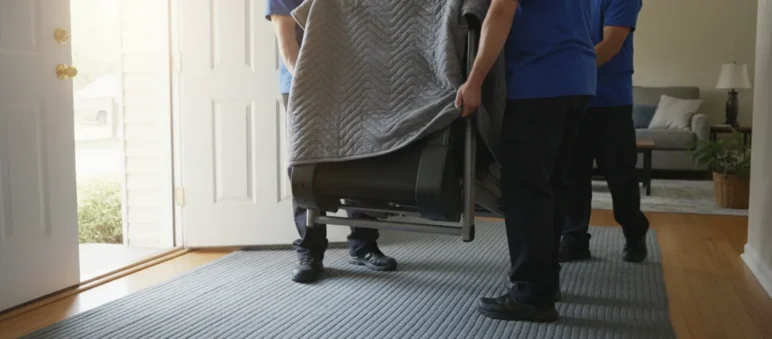
Planning a move with a treadmill means budgeting for more than the machine itself. Treadmill moving cost depends on weight, access, preparation, labor time, distance, and the protection your home and equipment need.
Request a treadmill moving estimate or call (800) 296-0417 to discuss your route.
A folding treadmill may look simple to move. Many models still weigh several hundred pounds. Their decks are long, their frames are tall, and their centers of gravity can shift on stairs. A realistic budget starts with the machine and the path it must take.
What determines treadmill moving cost?
There is no responsible flat price for every treadmill move. A compact folding model on a ground floor is different from a commercial treadmill in a basement. A local household move is also different from a one-item delivery across state lines.
For a local move, professional labor is generally priced by time. The crew, truck, standard moving equipment, and the work required for your move all affect the total. For an interstate move, pricing can also reflect shipment weight, mileage, extra services, bulky items, and selected valuation protection.
Ask the mover to identify the treadmill in the estimate. A written scope is more useful than a broad promise that the crew can handle heavy items. It should explain preparation, carrying, protection, loading, delivery, placement, and any assembly responsibility.
| Cost factor | Why it matters | What to provide before quoting |
|---|---|---|
| Machine weight | Heavy equipment may require more crew members and stronger handling equipment. | Model number, shipping weight, or a manufacturer specification sheet. |
| Dimensions | Length and height affect doorways, stair turns, truck placement, and room access. | Assembled and folded measurements, including console and handrails. |
| Stairs and turns | Flights, landings, narrow halls, and tight corners add time and handling risk. | Photos, a route sketch, and the number of flights at both addresses. |
| Disassembly | Removing rails or the console may make the route safer, but it adds preparation time. | Owner manual and a clear answer about who will disassemble and rebuild it. |
| Move type | Local work often uses an hourly structure, while long-distance work uses weight and mileage factors. | Origin, destination, dates, and whether the treadmill travels with household goods. |
| Protection and placement | Floor, wall, door, and machine protection take materials and careful labor. | Floor type, destination room, and any special placement request. |
These details also help a mover decide whether a treadmill is part of a standard household move or needs specialty handling. The distinction matters because a surprise at the doorway can change the crew plan.
How do stairs and access change treadmill moving cost?
Access is often the largest variable in treadmill moving cost. A machine can leave a garage through a wide opening, then face a narrow stairwell at the destination. Each route deserves its own review.
Measure the narrowest doorway first. Then measure the hallway width, stair width, landing depth, ceiling height, and the turn at each landing. Include baseboards, railings, light fixtures, and doors that cannot open fully.
Measure the treadmill in both assembled and folded positions. Folding reduces length on some models, but it does not always make the frame narrow enough for a turn. The console can also add height above the deck.
Share photos or a short video with the estimator. Show the full route from the machine to the truck. Include the front entrance, alternate entrances, stairs, elevators, ramps, and the room where the treadmill will sit.
Do not assume that a treadmill can be pulled by its handrails. The rails may not be designed as lifting points. The owner manual should guide disassembly and approved carrying points.
Request a detailed moving estimate that includes stairs, access limits, and treadmill placement.
How can you build a realistic treadmill moving budget?
A useful budget separates known costs from items that need confirmation. Start with the move type, then add the work created by the treadmill. This keeps a general household quote from hiding a special handling question.
- Identify the machine. Record the brand, model, approximate weight, dimensions, age, and condition. Save the manual if you have it.
- Map both routes. Count stairs and measure the tightest turns at pickup and delivery. Note elevators, ramps, gates, and parking limits.
- Choose the preparation scope. Confirm whether the mover will remove the console or handrails. Confirm whether the mover will rebuild the machine.
- Decide what travels together. Moving the treadmill with household goods may differ from booking a standalone specialty trip.
- Ask about protection. Confirm floor runners, padded blankets, door protection, machine wrapping, and placement in the destination room.
- Get the scope in writing. Check the estimate for labor assumptions, extra services, valuation protection, and possible storage.
For a local Delaware move, the estimate may use an hourly structure. The time can include preparation, protection, carrying, loading, travel, unloading, placement, and cleanup. Ask whether the estimate assumes a minimum number of movers.
For an interstate move, the treadmill can affect the shipment inventory and weight. Mileage, packing, bulky-item handling, storage, and valuation protection may also affect the total. The exact number requires a survey and a defined move scope.
A physical or virtual survey is especially useful for a heavy machine. It lets the estimator review the item and the property instead of relying on a short description. Delaware Moving & Storage does not use blind estimates for this planning process.
We have planned local and long-distance moves from our shop at 214 Bear-Christiana Road in Bear for more than 42 years. A treadmill survey can be physical or virtual. Either way, we look at the machine and the route before we write the price. Office hours are Monday through Friday, 8am to 4:30pm.
How can you compare treadmill moving estimates?
Compare estimates only after confirming that each mover received the same information. A low number may exclude stairs, disassembly, placement, packing, storage, or valuation protection. Those exclusions can make two apparently different prices describe different jobs.
| Estimate detail | Question to ask |
|---|---|
| Labor and crew | How many movers are included, and what work time does the estimate assume? |
| Access conditions | Are stairs, long carries, elevators, narrow turns, and parking limits included? |
| Preparation | Does the scope cover folding, disassembly, wrapping, parts storage, and reassembly? |
| Protection | Which floors, walls, doors, and treadmill surfaces will the crew protect? |
| Delivery | Does the estimate include placement in the final room or only delivery to the entrance? |
| Coverage | Which valuation protection option applies, and what documentation is required? |
Request the estimate in writing and keep the photos you provided. If the route changes, tell the mover before moving day. A new stair count or destination room can change the labor plan.
The best estimate is not always the lowest first number. It is the one that clearly describes the work, assumptions, exclusions, and protection. For another cost-focused planning resource, see the guide to moving and storage costs.
Should you move a treadmill with the rest of your household?
Moving the treadmill with the household can be efficient when the crew is already protecting floors, loading the truck, and traveling to the same destination. It can also simplify coordination when the machine is one item within a larger move.
A standalone move may make sense when the household move has already happened. It may also be useful for a purchase, a delivery to storage, or a move between rooms or properties. Ask whether the requested route and date fit the mover’s service area.
Storage adds another decision. A treadmill may need temporary storage when a home sale, renovation, closing date, or delivery schedule creates a gap. Ask how the machine will be prepared, where it will be placed, and how access works during storage.
Delaware Moving & Storage offers storage solutions for short-term and long-term needs. The right plan depends on the machine, the space, the length of storage, and the timing of delivery.
If your route crosses a state line, review the company’s long-distance and interstate moving service. Delaware Moving & Storage has been a Wheaton World Wide Moving agent since 1999. That network supports moves beyond a local Delaware route.
How should you prepare a treadmill before movers arrive?
Preparation lowers avoidable labor and protects the equipment. Start with the owner’s manual. Manufacturer instructions vary, so do not remove covers or wiring based on a generic online video.
- Remove the safety key and unplug the treadmill before preparation.
- Let the motor and belt stop completely before anyone handles the machine.
- Secure loose power cords so they cannot catch on wheels, stairs, or doorways.
- Remove bottles, mats, tablets, weights, and other accessories from the console.
- Record the machine’s condition with photos before disassembly or loading.
- Keep screws, washers, covers, and tools together in a labeled bag.
- Tell the mover about incline mechanisms, damaged parts, and unusual noises.
- Clear the route and protect pets, children, flooring, walls, and nearby furniture.
Do not lift a treadmill alone. Do not drag it by the power cord. Do not use the console, handrails, or protective covers as improvised handles unless the manufacturer specifically identifies them as carrying points.
A SOLE treadmill manual, for example, tells owners to unplug the unit before service and use proper lifting techniques. It also warns against moving the equipment until it is properly assembled. Read your own manufacturer manual and safety instructions before the move.
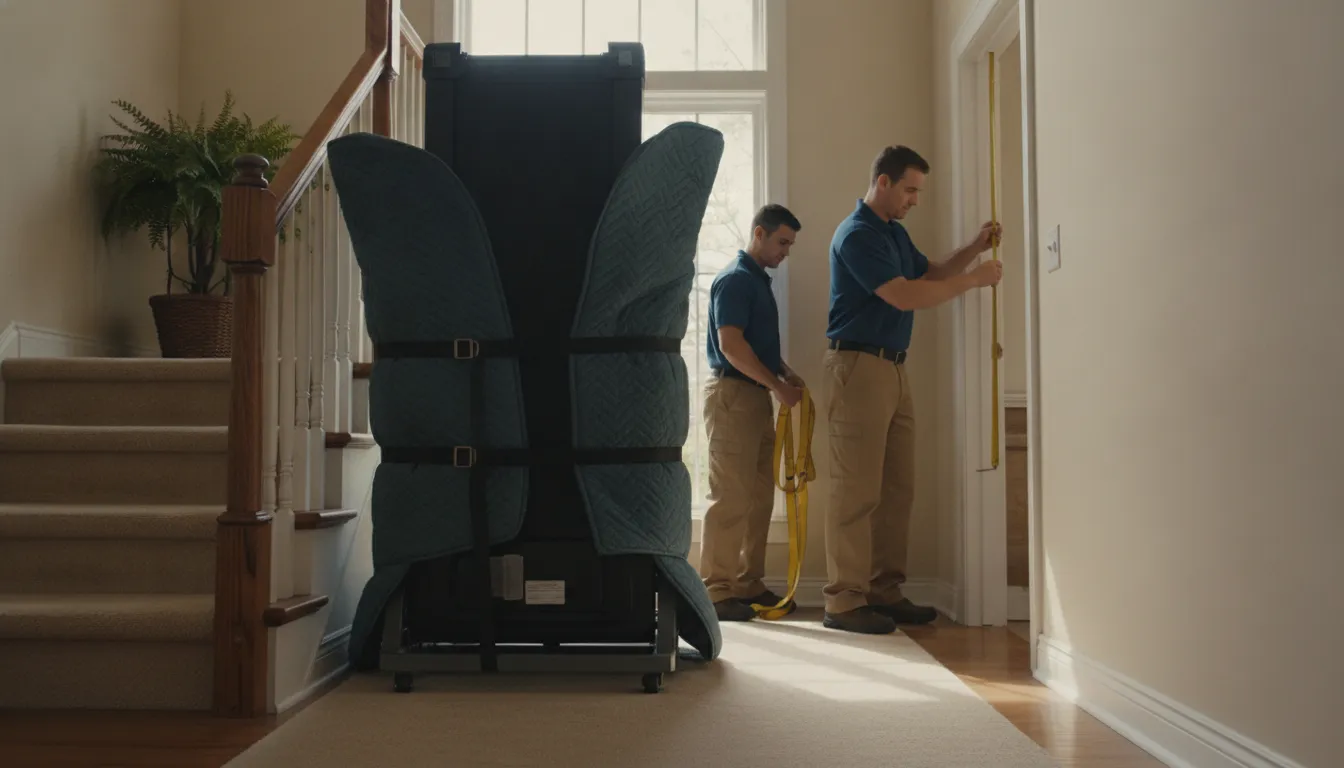
Professional movers can use floor runners, furniture pads, stretch wrap, hand trucks, four-wheel dollies, and other equipment. The correct setup depends on the route and the treadmill’s condition. Ask what the crew will use before moving day.
For broader preparation, review this Delaware moving day guide. If you want the crew to pack accessories or nearby equipment, ask about professional packing services before the estimate is finalized.
What should you ask before booking treadmill moving help?
Good questions reveal whether a quote covers the work you actually need. They also give you a written record when the machine is heavy, valuable, or difficult to access.
- Have you moved similar treadmills, including models with stairs or tight turns?
- How many crew members does this route require?
- Who handles disassembly, packing, and reassembly?
- Which parts of the treadmill should remain attached?
- Will the crew protect floors, walls, door frames, and the machine?
- Is the treadmill included in the written inventory and estimate?
- Are stairs, long carries, elevators, parking, storage, or special equipment priced separately?
- What valuation protection applies if the equipment is damaged?
- Where will the treadmill be placed at delivery?
- What happens if the machine does not fit through the planned route?
Ask for clear answers before moving day. A vague answer can leave you comparing different scopes instead of different prices.
For a broader quote review, read how to compare moving estimates. The estimate should make services, assumptions, access conditions, and protection options understandable.
Get a written estimate for your treadmill move after sharing the model, route, stairs, and placement details.
Frequently asked questions about treadmill moving cost
How much does it cost to move a treadmill?
The amount depends on the machine, route, labor time, preparation, stairs, distance, protection, and move type. Local moves commonly use an hourly structure, while interstate moves use weight and mileage factors. A survey produces a more reliable number than a generic online range.
Do movers charge extra for treadmill stairs?
Stairs can change the labor plan, crew size, equipment, and time. Some movers include the work in an hourly estimate. Others identify special handling or access charges. Ask the estimator to inspect and name every stair flight in the written scope.
Should I disassemble my treadmill before moving it?
Follow the model’s manual and the mover’s instructions. Some treadmills can be folded or partially disassembled. Others require specific tools or carrying points. Do not remove covers, wiring, or safety parts unless the instructions allow it.
Can a treadmill go into storage?
Yes, when the storage plan and facility can accommodate it. Confirm preparation, placement, access, protection, and the expected storage period. Ask whether the treadmill will be stored with household goods or handled as a separate item.
Is a treadmill covered by moving valuation protection?
Coverage depends on the move contract and selected protection. Ask how valuation applies to the treadmill, including age, condition, repair, replacement, exclusions, and documentation. Review the terms before the crew arrives.
On an interstate move, federal rules require two choices. Released value is included at 60 cents per pound per article. Full value protection costs extra. The FMCSA valuation protection guide explains that difference. Sixty cents a pound will not replace a treadmill, so confirm the option on your written estimate.
What information helps a mover quote a treadmill accurately?
Provide the brand, model, weight, dimensions, photos, origin and destination, stairs, narrow turns, elevator details, parking limits, preparation needs, and final placement. A physical or virtual survey can confirm the route and reduce surprises.
Request your treadmill moving estimate today and call (800) 296-0417 with questions about your Delaware move.
Delaware Moving & Storage serves northern Delaware and the surrounding tri-state area with local, long-distance, storage, packing, and specialty moving support. The team can review your treadmill, access route, and timing before preparing a clear estimate.