
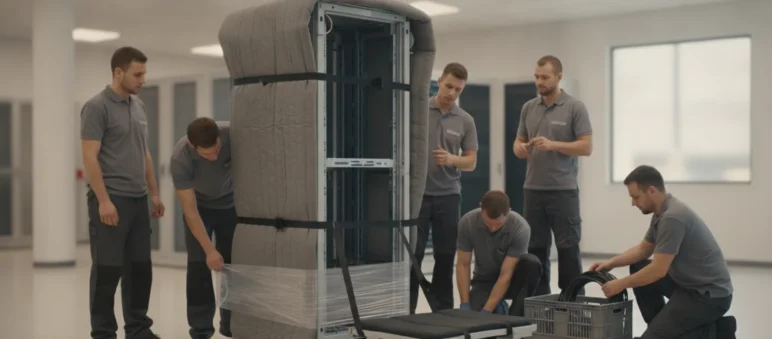
Moving a server rack cost depends on more than the distance between two buildings. Rack dimensions, equipment weight, building access, protection, and the work required before and after transport all affect the estimate. A clear inventory and site plan help you compare estimates on the same scope.
What affects moving a server rack cost?
A server rack may hold equipment that is heavy, sensitive to shock, and difficult to handle in a confined space. A useful estimate reflects the rack and its route, rather than relying only on a generic hourly or distance figure. Share details early so the moving team can assess the work.
- Rack size and load: Provide height, width, depth, approximate loaded weight, and an inventory of installed equipment. A tall, full rack presents different handling needs from an empty frame.
- Distance and route: Include origin and destination addresses, travel distance, vehicle restrictions, and whether the move crosses state lines.
- Building access: Stairs, narrow corridors, elevators, loading docks, ramps, and long carries can change labor and equipment needs. Note floor numbers, door widths, elevator dimensions, and dock availability.
- Preparation and packing: Disconnecting, labeling, removing equipment, packing components, and protecting the rack are separate tasks. Clarify which work your IT team will handle.
- Timing and coordination: Explain access windows, building approvals, security check-ins, elevator reservations, and any planned service interruption.
- Delivery and placement: Specify whether delivery ends at curbside, inside the building, or at a particular room and position. Reinstallation, reconnection, and testing should be stated separately.
How should you compare a server rack moving estimate?
Ask each provider to price the same move in writing. A lower total may omit preparation, unusual access, or final placement. Read the scope for what is included, what is excluded, and what your staff must do.
| Estimate item | Questions to ask | Why it matters |
|---|---|---|
| Handling scope | Is the rack moved loaded or emptied? Who removes and secures equipment? | Changes labor, protection, and handling plans. |
| Access | Are stairs, elevator use, dock appointments, and long carries included? | Access can add time or require different equipment. |
| Packing | What materials and protective measures are included? | Clarifies responsibility for the rack and loose parts. |
| Transport | Which locations and route does the estimate cover? | Confirms that the quoted trip matches the plan. |
| Placement and services | Does delivery include positioning, unpacking, reconnection, or testing? | Prevents assumptions about technical work. |
| Estimate basis | Is the estimate based on hourly labor, weight and mileage, or a defined scope? | Shows how changes might affect the total. |
For local moves, ask how labor is measured and what conditions could change the time required. Long-distance and interstate moves use a different estimate basis, so ask how shipment weight and mileage apply. Delaware Moving & Storage prepares estimates after physical or virtual surveys rather than relying on a blind estimate. Review its moving services and estimate options before you request a review.
What information should you gather before requesting a quote?
Prepare a concise move brief. You do not need every technical specification, but accurate details help identify access and handling concerns in advance.
- Describe the equipment. Record rack count, approximate dimensions and loaded weight, and whether equipment will remain installed. Note unusual or fragile components.
- Photograph the route. Take pictures of the rack, exits, corridors, elevators, stairs, loading areas, and destination room. Measure tight doorways and turns when possible.
- Confirm building rules. Ask about dock reservations, service elevators, access paperwork, security escorts, and permitted work hours.
- Assign technical responsibilities. Decide who will shut down systems, disconnect and label cables, remove equipment, reconnect it, and test it. Do not presume that physical moving includes IT installation.
- Set delivery requirements. Identify the room and placement point, whether packaging should be removed, and whether the receiving site is ready.
- Request a survey. Share the brief and ask for a physical or virtual review when access or load details are complex.
For a business relocation involving other work areas, a commercial moving plan can help coordinate the rack with office items. Read the company’s moving preparation guidance and identify which items need to arrive first.

What can a sample planning brief look like?
A useful brief is short enough to review quickly but specific enough to reveal the work. For instance: “One rack, approximately seven feet tall, currently populated; origin suite 210, second floor, service elevator reserved; destination room 104, ground floor; IT team will shut down, disconnect, and reconnect; moving crew to protect, load, transport, unload, and place rack; no network testing included.” Replace these illustrative details with verified measurements and responsibilities for your own move.
Add photographs and measurements as attachments, rather than trying to describe every turn in a paragraph. Mark the location of the rack, the route to the vehicle, and the intended destination spot. Include a site contact and a backup contact for each building. If the rack contents or plan change after the estimate, tell the estimator and ask whether the written scope needs updating.
This preparation also helps you compare quotes consistently. Give each provider the same inventory, access details, route images, and task list. Keep a copy of each response and compare the included work line by line. If one estimate is much lower, first check whether it excludes packing, difficult access, or placement rather than assuming the difference reflects a better price.
Should you move a server rack loaded or empty?
There is no universal answer. The equipment manufacturer, rack construction, total weight, and handling plan matter. Ask your IT lead and equipment provider whether installed hardware should be removed before transport. Have the moving team review the proposed approach, especially if the rack is tall, densely loaded, or difficult to maneuver.
Moving an empty rack may make it easier to control, but adds removal, packing, and reinstallation tasks. Keeping equipment installed may reduce those tasks but increase weight and make stabilization more important. Do not substitute a general rule for equipment-specific guidance. Include the planned approach in the estimate request so the scope reflects the actual work.
How do access conditions change the move plan?
Two moves of similar distance can require different labor because the route from the rack to the vehicle and from the vehicle to the destination can vary. A ground-floor room near a loading dock is not the same as a rack on an upper floor with a small elevator and a long corridor.
Walk the full path at both sites. Measure door openings and elevator interiors, including height, width, and depth. Check turning space at corners and whether thresholds, ramps, or steps interrupt the route. Record which doors require keys or a staff escort. A photograph helps, but measurements are more useful when a clearance is close.
At the destination, confirm that the room can accept the rack before the scheduled delivery. Clear floor space, reserve elevator time, and arrange access with building management. If the rack cannot reach the planned room, the crew may need to pause while another route or location is agreed upon. Raise concerns during the estimate process, not at the loading dock.
How can you plan downtime and protect data?
The moving estimate covers physical work; business continuity requires a separate plan. Coordinate the service interruption with the people responsible for systems, backups, network connections, and building access. Define who makes each decision and who has authority to approve a change on moving day.
- Confirm shutdown and restart sequences with your IT team.
- Verify backups and document who checks them before and after transport.
- Label cables and connections at both ends; keep the labeling key with an authorized staff member.
- Secure loose accessories and hardware in identified containers that stay associated with the correct rack.
- Keep configuration records and access credentials with authorized staff rather than packing them with equipment.
- Agree who inspects the equipment, reconnects it, and confirms operation after delivery.
For a simple example, a business moving one rack between nearby offices might schedule shutdown after the last service window, have IT disconnect and label components, and have staff meet the moving crew at both buildings. A larger office relocation may require a staged sequence: move noncritical equipment first, confirm the destination is ready, then schedule the rack around the systems that must return to service. These are planning examples, not promises about a specific duration.
Keep technical work separate from physical moving unless the written scope specifically assigns it. Delaware Moving & Storage handles commercial moves; equipment configuration and network testing should be assigned to qualified IT personnel. See the company’s commercial moving information when the rack is part of a broader office relocation.
How do responsibilities affect the estimate?
A practical way to prevent gaps is to make a responsibility list before requesting an estimate. Treat the rack move as several connected jobs rather than one vague task called “move the server.” The business owns system decisions, the moving provider scopes physical handling and transport, and building contacts control site access. Some duties may be shared, but each one should have a named owner.
| Task | Owner to confirm | Detail to settle |
|---|---|---|
| Shutdown and backup check | IT lead | Who authorizes shutdown and confirms recovery readiness? |
| Disconnect and label | IT staff or contracted technician | Which cables and components are removed, labeled, and packed? |
| Physical protection and loading | Moving team, per written scope | How is the rack protected and handled on the route? |
| Building access | Facilities or building contact | Who reserves elevators, docks, and security escorts? |
| Placement and restart | IT lead and site contact | Who directs placement, reconnects equipment, and tests service? |
Use this list to identify exclusions in each estimate. For example, an estimate may include transport and room placement but not shutdown, cable work, or post-delivery testing. That can still be a workable arrangement if your IT team has agreed to handle the excluded tasks. It becomes a planning risk if everyone assumes another party will do them.
Ask for unfamiliar terms to be explained in plain language. Confirm whether packing materials, protective wrapping, loading, unloading, and placement are included. If the move includes multiple racks, ask whether the estimate describes each rack separately or treats them as one shipment. A written inventory makes scope changes easier to recognize.
Which costs can be reduced through better planning?
You cannot remove necessary handling or transport from the plan, but you can reduce avoidable uncertainty. The best way to do that is to define the scope early and make the site conditions visible before the estimate is prepared.
- Prevent repeat visits: Provide accurate addresses, room locations, access hours, and contact names so the team can plan arrival and entry.
- Avoid waiting on approvals: Reserve docks and elevators, arrange security access, and confirm building rules in advance.
- Reduce last-minute scope changes: List equipment, accessories, packing needs, and placement expectations in one written brief.
- Assign work clearly: Decide who handles shutdown, disconnection, packing, reconnection, and testing; avoid duplicate or missing assignments.
- Coordinate other items: If the rack is moving with office furniture, identify separate priorities and any items that must travel on a different schedule.
Do not omit a difficult access condition or understate the load to make an estimate look simpler. The estimate should represent the actual move. A complete brief helps the provider discuss the required work and makes competing estimates easier to compare fairly.
What should you confirm for a move across state lines?
For an interstate shipment, confirm which company is responsible for the move, the locations covered, and the estimate basis. Ask what documentation or inventory the provider needs and keep the accepted scope with your move records. The Federal Motor Carrier Safety Administration provides consumer information about interstate moving at FMCSA; consult official guidance when checking interstate carrier and move-related requirements. Do not treat a web page as a substitute for reviewing the specific written estimate and paperwork for your shipment.
Distance alone does not tell the whole story. A move between neighboring states can still involve building rules, road access, and a particular delivery window agreed with the receiving site. Confirm whether the estimate covers the complete origin-to-destination route and whether any requested services are separate. Delaware Moving & Storage is an agent for Wheaton World Wide Moving for long-distance and interstate relocation; ask how the rack fits into the shipment plan.
What should Delaware businesses consider?
Delaware Moving & Storage serves northern Delaware and nearby areas, including Chester and Delaware Counties in Pennsylvania and Cecil County, Maryland. For a move beyond those local service areas, confirm availability and the appropriate service. The company is an agent for Wheaton World Wide Moving, supporting long-distance and interstate relocation.
When the rack is part of an office move, provide an inventory of other items and identify which assets must arrive first. Check whether the destination has a suitable route, clear floor space, and appropriate power and network connections ready before delivery. Review service area information and Wheaton moving information while planning.
Frequently asked questions
Can I get a reliable price from rack dimensions alone?
Dimensions help, but they do not show loaded weight, equipment inside, building access, distance, or delivery scope. Provide those details and request a survey when conditions are complex.
Does a moving estimate include disconnecting and reconnecting servers?
Do not assume it does. Ask for each task to be listed clearly. Shutdown, cabling, system configuration, and testing should be assigned to your IT team unless expressly included.
Will a local mover transport equipment to another state?
Some movers offer interstate service through a van line or network. Confirm that the origin and destination are covered and ask how the estimate is calculated. Delaware Moving & Storage is an agent for Wheaton World Wide Moving.
What if my rack is in a building with no loading dock?
Tell the estimator in advance. Share floor, elevator, stair, and parking details, plus photographs if possible. The access plan may affect the labor and equipment required.
Should I pack cables and accessories with the rack?
Keep loose parts identified and protected, but ask your IT lead how cables and removable components should be handled. Label containers clearly and keep critical records and credentials with authorized staff.
Request a detailed estimate
Before contacting a mover, gather rack details, route photographs, building requirements, and a list of technical tasks your staff will handle. Delaware Moving & Storage uses physical or virtual surveys to prepare detailed estimates for planned moves. Its contact page is the place to begin.
A written scope covering handling, access, transport, and delivery gives your business a clearer basis for planning the move.