
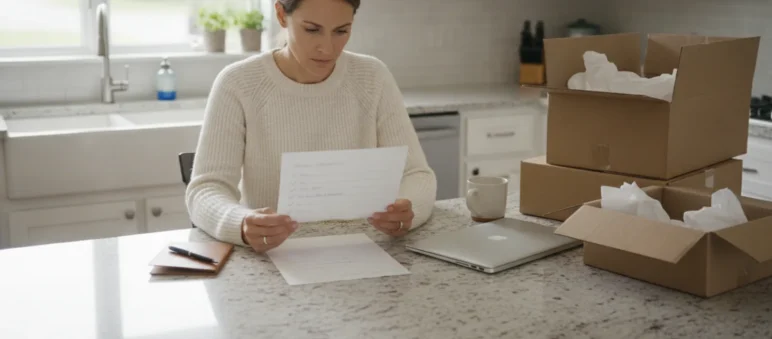
A Delaware moving address change involves more than forwarding mail. You may need to update your address with the post office, banks, insurers, utilities, employers, schools, and government agencies. Starting early helps you avoid missed bills, interrupted service, and important mail going to your old home. In this guide, Drew Hopkins, General Manager of Delaware Moving & Storage, walks through practical steps to organize updates around your move date, whether you are moving within northern Delaware or relocating to nearby Pennsylvania or Maryland.
When should you start changing your address?
Begin making a list as soon as you know you are moving. Some updates are quick, while others may require a new account, proof of residency, or a scheduled appointment. Start with providers that affect essential services and payments. Then work through personal accounts and less frequent contacts.
A simple timeline can keep tasks manageable:
- Several weeks before moving: Confirm your move date, make a list of accounts, and contact utility providers, schools, insurers, and medical offices.
- About two weeks before moving: Submit your mail-forwarding request and update employers, banks, subscriptions, and recurring deliveries where possible.
- Moving week: Confirm service start and stop dates, keep essential documents accessible, and check that your new address is recorded correctly.
- After you arrive: Update any account that needs your new address to be verified in person or with documentation, and check that mail and bills are reaching you.
Timing varies by provider, so confirm deadlines directly with each organization. If your move date changes, contact providers promptly instead of assuming an earlier request will adjust automatically.
It helps to separate the work into two passes. In the first pass, notify organizations that must schedule a service change, send a document, or confirm a deadline. In the second, handle routine accounts that can be changed online. That way, a delayed appointment with an insurer or utility does not keep you from updating a streaming account or magazine subscription. Mark the requested effective date beside each task; the date you submit a form and the date a change takes effect are not always the same.
Which address-change tasks should you handle first?
Not every address update has the same consequence. Prioritize services and records that can affect access to your home, money, health care, or legal notices. Use the table as a starting point, then tailor it to your household.
| Priority | Who to contact | What to confirm | When to handle it |
|---|---|---|---|
| Essential service | Electric, gas, water, internet, and waste providers | Stop and start dates, service address, account holder, equipment return | As soon as the move date is firm |
| Mail and payments | Postal service, banks, credit card companies, and lenders | Forwarding, billing address, delivery address, payment notices | Before moving, then verify after |
| Health and coverage | Doctors, pharmacies, health, auto, and home insurers | Records, prescriptions, policy address, coverage territory | Before or shortly after the move |
| Legal and government | Vehicle and voter records, tax agencies, benefits offices | Applicable forms, address deadlines, proof requirements | Check requirements early |
| Daily routines | Employer, school, childcare, subscriptions, and delivery accounts | Contact details, pickup plans, delivery destination | Before the first day at the new address |
When a provider has more than one address field, treat each as its own task. A bank may store a mailing address separately from the address used to assess an account or send a replacement card. A utility account has a service address as well as a place to send bills. For each organization, write down which fields you changed instead of marking the whole account complete after editing just one.
How do you arrange mail forwarding?
Mail forwarding can help route eligible mail from your old address to your new one, but it should not be your only address update. Submit a change-of-address request through the postal service’s official process, and check the current instructions, identity-verification steps, fees, and timing before you submit it. Avoid unfamiliar third-party sites that imitate official forms.
Forwarding does not necessarily update the address held by a bank, government agency, insurance company, or subscription provider. Contact those organizations directly. Some mail may not be forwarded, and packages or time-sensitive items can follow different rules. Ask important senders how they handle address changes.
Before you submit the request, check these details:
- Use the exact old and new street addresses, including apartment or unit numbers.
- Choose the correct household or individual option based on who is moving.
- Set the requested start date carefully and save the confirmation.
- Tell household members which mail is being forwarded and when to check the new mailbox.
- Keep an eye on both addresses during the transition, if you still have access to the old one.
If someone in the household is staying behind, do not assume one request will handle everyone’s mail correctly. Review the postal service’s current guidance and make sure the request reflects who is actually relocating.
Use forwarding as a safety net while you work through your sender list. When a forwarded envelope arrives, note the sender and update the address directly. This can reveal accounts you forgot to include, such as a professional association, a benefits administrator, or a company that sends an annual notice rather than a monthly bill. Do not put off that direct update simply because the envelope reached you; forwarding is a transition measure, not proof that the sender has your new address.
What should you update before leaving your current home?
Utilities and home services
Contact electricity, gas, water, sewer, internet, cable, and waste providers. Ask when service can be stopped at the old address and started at the new one. Some providers may need access to a meter, equipment, or the property. Record confirmation numbers and keep a note of final readings or final bills where applicable.
For a home you own, also check any alarm monitoring, lawn care, pest control, and maintenance contracts. For a rental, review move-out instructions and confirm how to return keys or equipment. If you are moving into a building with managed utilities, ask the property manager which services you must arrange yourself.
Make two columns in your notes: “old home” and “new home.” Under the first, list stop dates, final bills, and items to return, such as a modem or cable equipment. Under the second, list the account holder, activation date, installation appointment, and access instructions. This makes it easier to see a gap, such as internet service ending before the new connection can be installed. Confirm that the provider has the correct unit number and that someone can be present if access is needed.
Financial accounts and recurring payments
Update your address with banks, credit unions, credit card issuers, mortgage or loan servicers, investment providers, and tax preparers. Check both the mailing address and the billing address; an account may store them separately. Review automatic payments and electronic statements, too. A card payment can continue while paper notices still go to the old address.
Also review payment services, workplace benefit accounts, and any account used for identity verification. Use the provider’s official website or phone number, and do not send sensitive account details in an unsecured message.
Check accounts one at a time rather than assuming a profile update changes every product held by the same institution. A household may have a checking account, a credit card, and a loan serviced through related but separate systems. After making each change, look for a confirmation screen or message and note the date. If you receive paper statements, check the next one for the correct address. If you have payments scheduled near the move date, leave enough time to verify that statements and notices remain available through the transition.
Insurance, health care, and prescriptions
Tell your health, auto, renters, and homeowners insurance providers that you are moving. Ask whether the address changes coverage, premiums, eligible networks, or policy documents. Do not assume a policy transfers unchanged to another state. If you are moving across state lines, confirm what steps and deadlines apply to your situation.
Ask doctors, dentists, pharmacies, and other providers to update contact and billing records. If you are changing providers, request the process for transferring medical records and prescriptions. Keep medication and essential health documents with you rather than packing them in a box that will be hard to reach.
When you contact a health office, ask whether the address update applies to every person in the household or whether each patient needs a separate change. Confirm where appointment reminders and billing notices will go. If a prescription is due near the move, ask the pharmacy what information it needs to keep the refill process clear. For insurance, write down the representative’s instructions and any documents or follow-up you need; do not rely on an assumption that a new address alone completes a policy change.
Employer, school, and household contacts
Update your employer’s payroll and benefits records, as well as emergency contacts if needed. Families with school-age children should contact the current and new school about enrollment dates, records, transportation, and proof of residency. If a child attends childcare or after-school programs, update pickup permissions and emergency details.
Tell people who need to reach you, such as family members, caregivers, and professional advisers. If you use a home-based business address, check whether your business registrations, invoices, licenses, or customer-facing contact details need to change as well.
For school and childcare updates, make a short list of practical items to confirm: the date the new information should take effect, the documents the office wants, how records are transferred, and whether pickup arrangements change on the first day. If only part of the household is moving at first, state that clearly so that staff do not treat every contact as relocated. For work, update both payroll and any separate benefits, emergency-contact, or reimbursement profile you use. A payroll address and an office location are not necessarily the same field.
What should you update after moving to a new Delaware address?
Once you have access to the new home, confirm that your address appears correctly on accounts and official records. Rules differ by agency and by whether you moved within Delaware or across a state line. Check the current instructions for each agency rather than relying on one general checklist.
- Vehicle and driver records: Review the applicable motor-vehicle agency’s process for changing an address, updating a license or registration, and handling an out-of-state move.
- Voter registration: Check your election office’s instructions for updating your registration and confirming your voting location.
- Tax and benefit records: Update relevant federal, state, and local agencies, plus any benefits or pension administrator that sends notices.
- Property or rental records: Make sure your landlord, homeowners association, property manager, or mortgage servicer has the correct contact address.
- Online accounts and delivery apps: Remove the old address from saved checkout, ride, grocery, and package-delivery profiles.
For a move within Delaware, your state-agency steps may differ from those for a move to Pennsylvania or Maryland. Check each agency’s instructions and deadlines. Delaware Moving & Storage serves northern Delaware and nearby communities in Chester and Delaware Counties, Pennsylvania, and Cecil County, Maryland; you can review the service area information when planning a move across the region.
Do not wait until you need a document or notice to confirm that a record is current. Add the agency update to your list, visit the agency’s official instructions, and note the effective date or confirmation. If a move crosses a state line, separate the tasks into “leaving state” and “arriving state” rather than treating them as one form. You may need to contact different offices for a driver record, vehicle record, voter record, tax correspondence, and benefits. The exact process depends on the agency and your circumstances, so confirm details directly before relying on a general checklist.
How can you keep your address-change process organized?
A single list is often easier to maintain than scattered notes and confirmation emails. Create a spreadsheet or paper checklist with one row per organization. Include the contact details, date requested, effective date, confirmation number, and whether the change has been verified.

Use a simple status system such as “to do,” “submitted,” and “confirmed.” Mark a task confirmed only after you see the new address on a statement, account profile, or official confirmation. If a provider cannot accept the update yet, record the date to follow up.
Store sensitive paperwork safely. Keep a digital copy of confirmations in a secure location, and avoid writing full account numbers or other private information on a checklist that may be misplaced. Keep a small folder with lease or closing paperwork, utility confirmations, moving documents, and identification that you may need during the transition.
A useful tracking row might read: “Electric provider — old address stop date requested — new address start date confirmed — confirmation saved — check first bill.” Another might read: “School — records transfer requested — enrollment documents needed — follow up with office.” These notes make the next action clear to another household member if you share the work. If you prefer paper, keep the list in a folder that travels with you rather than in a box. If you use a digital document, choose a secure account and share access only with people who need it.
Set a brief check-in once or twice each week during the transition. Review anything still marked “submitted,” check for changed move dates, and follow up on requests without a response. After moving, look at the first bill or account notice from high-priority providers. A request confirmation shows that you submitted an update; a later account view or statement helps confirm that it took effect.
How does the move itself affect your address-change plan?
Address updates are easier when you know what is moving and when. Your move plan should include the dates you need access to both homes, the arrangement for keys, and any building rules that affect loading or unloading. Make a list of items you will carry yourself, such as medications and important documents, so they are not mixed into packed household goods.
If you are still preparing the household, use the company’s moving tips and move preparation guidance to plan practical next steps. For help deciding what kind of service fits your move, review the available moving services. A local move and an interstate move may involve different planning needs, so describe both addresses and your expected move date when requesting an estimate.
Delaware Moving & Storage is a family-owned relocation company serving the tri-state area from northern Delaware. The company is an official Wheaton World Wide Moving agent, a detail that may be relevant when planning a long-distance or interstate relocation. You can learn more about the company’s history and local ownership or its Wheaton relationship.
Think about the move sequence as well as the mailing sequence. If you will not have access to your new home on the same day you leave the old one, decide where deliveries should go in the interim. Update delivery profiles only when you are confident the new location can receive them. For an apartment or managed building, ask about package procedures, entry instructions, and any limits on delivery times. Remove the old address from saved checkout choices once the new address is active; keeping both in a profile can lead to an accidental order sent to the wrong place.
If your move date is still tentative, tell service providers that when asking about options. Avoid requesting a stop date before you know when you will hand over the home unless the provider explains how to revise it. Keep your moving paperwork, identification, medications, chargers, and the address-change checklist with you. Having those items accessible is useful if a provider asks you to verify account details while boxes are being unloaded.
What address-change mistakes should you avoid?
- Relying only on mail forwarding: Forwarding can help, but it does not replace direct updates with account holders and agencies.
- Forgetting separate addresses: An account can have distinct mailing, billing, service, and delivery addresses. Review each field.
- Leaving out unit details: Apartment, suite, building, and directional information can affect delivery. Match the address format used by the property or provider.
- Updating too late: Some changes require processing time or documentation. Contact providers early and ask what they need.
- Assuming a state-to-state move is the same as a local move: Cross-state moves can involve different agency steps. Check requirements for the new state.
- Not verifying the change: Save the confirmation and check a later statement or account page to make sure the update took effect.
- Sharing personal information with an unverified site: Use official provider channels when submitting addresses, identity documents, or payment details.
Two small habits can prevent many of these problems. Read the complete address back before submitting it, especially the unit number and ZIP code, and save the confirmation before closing the page. Then revisit the account after the move to check what is on file. If the address is wrong, contact the provider through its verified channel and ask how to correct it. Keep a note of the date and the person or department you contacted, without putting private account details in an unsecured checklist.
Frequently Asked Questions
Is mail forwarding enough when I move?
No. It can help route eligible mail, but you should also update your address directly with banks, insurers, employers, medical providers, government agencies, and anyone who sends important notices. Check the postal service’s current rules to learn which items are eligible and how to submit a request.
Should I change my address before I move?
For many accounts, you can submit an update in advance and choose an effective date. Other organizations may require you to wait until you have moved or can verify the new residence. Ask each provider when to submit the change and what proof it needs.
What if I am moving from Delaware to Pennsylvania or Maryland?
Update your mailing and service addresses as usual, then check the relevant agencies in the new state for driver, vehicle, voter, tax, and benefit requirements. Do not assume that changing an address with one agency updates every record.
How do I make sure bills reach my new home?
Update both billing and mailing addresses with each provider, turn on electronic notices if useful, and verify the change in your account or on the next statement. Keep a record of your request and follow up if the old address still appears.
What should I do if I do not know every account that has my old address?
Review recent mail, bank and card statements, saved online profiles, recurring payments, and household paperwork to identify senders. Keep monitoring mail during the transition and update each sender directly when you find it.
Request an in-home moving estimate
Make your move easier to track
Work through the checklist one provider at a time, save confirmations, and verify that important records show your new address. If you are still planning the move, Delaware Moving & Storage can help you discuss the relocation and request an estimate through the contact page. A clear schedule gives you more time to settle in and fewer address details to chase later.