
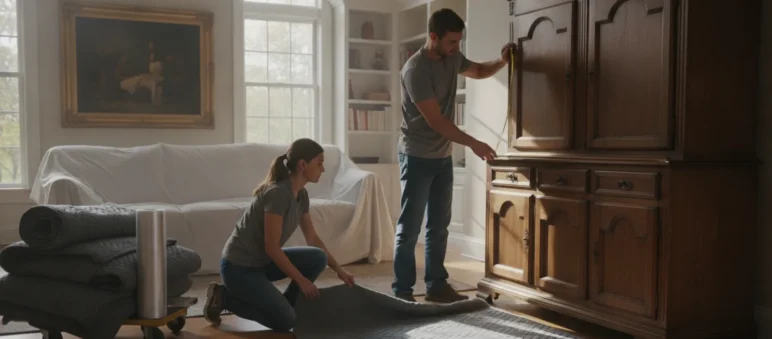
The cost of moving an antique depends on the work required to protect and transport that particular piece—not simply its age or estimated value. Size, condition, packing, access, distance, and whether the item travels with a household shipment all affect the plan. If you are moving in northern Delaware or planning a longer trip, a clear inventory and a physical or virtual survey are useful starting points.
What goes into the cost of moving an antique?
There is no single rate that fits every antique. A compact, sturdy piece may need careful wrapping and normal loading. A tall cabinet with glass, a carved table with loose joints, or a delicate object with parts that detach can require a different packing and handling plan. Movers need to understand both the piece and the route before they can estimate the work involved.
Consider these cost factors when you describe the move:
- Dimensions and weight: Height, width, depth, and weight affect how many people may be needed, what equipment could help, and how the item fits in the vehicle. If you do not know its weight, say so rather than guessing.
- Construction and condition: Glass panels, veneers, fragile finishes, carved projections, loose joints, or existing damage may change how the item should be supported and protected. A note about a wobbly leg or sticking drawer is useful information, not a repair request.
- Packing requirements: Protective wrapping, cushioning, securing removable pieces, or a crate can involve added materials and labor. The right approach depends on the item’s construction and the move.
- Pickup and delivery access: Stairs, narrow halls, tight turns, elevators, long walks to the truck, parking limits, and building rules can affect the work. The route through each building matters as much as the item itself.
- Distance and service type: Local moving is generally priced by hourly rates, while long-distance moving pricing is based on weight and mileage. The services included in the estimate also matter.
- Shipment size and scheduling: An antique that travels with a household shipment is planned differently from one transported by itself. Delivery timing, storage needs, and other items on the inventory should be discussed.
These factors interact. A glass-front cabinet might be straightforward to move from a ground-floor room with a wide exit, but demand more planning if it must pass through a narrow upstairs landing. A heavy table with a delicate finish could call for a different combination of support and protection than a small solid-wood chair. Cost is best understood as the estimate for the actual work, not a generic charge based on the word “antique.”
A Columbia University moving guide lists special handling for antiques among possible moving cost components. That is a useful reminder that a piece’s handling needs belong in the planning discussion, but it does not set a price for any specific move.
Which details should you gather before asking for an estimate?
A short preparation pass helps the mover make an informed plan and reduces the chance of leaving important details out of the survey. Start with what you can observe. You do not need to identify the piece’s maker or establish its market value to describe how it will be moved.
- Measure the outside: Record the maximum height, width, and depth, including protruding handles or trim. For a large piece, measure the widest point and note if any parts are removable.
- Photograph all sides: Take clear images of the front, back, sides, top, and any special features. Include existing chips, cracks, looseness, or repairs in close-up photographs.
- Describe the construction: Note whether the item has glass, mirrors, stone, a delicate finish, projecting details, or removable shelves and hardware. If you are unsure what a part is, take a picture and label it in your notes.
- Write down the access: Count stairs, mention elevators and reservations, and identify tight doorways, sharp turns, low ceilings, or long carries. Share building or parking restrictions at both ends.
- Confirm the addresses and route: Provide pickup and delivery locations, the expected move type, and whether the antique is part of a larger household shipment.
- List open questions: Record who will pack, what happens to removable parts, whether storage might be needed, and what protection options you want explained.
Use a simple inventory entry for each item: name or description, dimensions, room location, condition notes, photographs, and any known handling concern. For instance, “wooden display cabinet, approximately 70 inches high, glass doors, one loose shelf, second-floor room” gives more useful planning information than “old cabinet.” If you do not know a measurement or material, mark it as unknown. A mover can clarify what should be checked during the survey.
Make sure the inventory matches what the crew will see on moving day. If you decide to include another piece, change the room it is in, or learn that a component cannot be removed, update the estimate discussion. Clear information helps keep the plan aligned with the job.
How can you compare antique moving estimates?
Compare the work described, not only the total at the bottom of each estimate. If one estimate includes packing and the other assumes you will prepare the piece, the amounts do not describe the same service. Likewise, a quote based on a ground-floor pickup should not be compared directly with one that includes stairs and a long carry.
| Estimate detail | What to confirm | Why it matters |
|---|---|---|
| Item and condition | Which pieces are listed, their dimensions, condition notes, and photographs | Confirms the estimate reflects the actual items and concerns |
| Packing and preparation | Who packs, what materials or services are included, and how detachable parts are handled | Separates included labor and materials from work you may need to arrange |
| Pickup and delivery access | Stairs, elevators, distance to truck, parking, and any building requirements | Shows whether the move plan accounts for the route at both addresses |
| Pricing basis and shipment | Hourly local rate or weight- and mileage-based long-distance pricing, plus what shipment is covered | Helps you understand how the move type and shipment details affect the estimate |
| Storage or extra service | Whether storage, later delivery, or special packing is listed as included or separate | Makes it easier to compare the complete service scope |
| Protection questions | Available valuation protection options, terms, and relevant limits | Clarifies what choices are being discussed without treating an appraisal as coverage |
This is a comparison checklist, not a price schedule. Ask for a written estimate that states the services included, the pricing basis, and the assumptions used. Ask what could change the amount, such as a different inventory, undisclosed access conditions, or a change in packing scope. Delaware Moving & Storage uses physical or virtual surveys rather than blind estimates; the survey gives the company an opportunity to understand the move before preparing a detailed estimate.
For a local move, ask how the hourly pricing applies to the services and inventory being discussed. For a long-distance move, ask how shipment weight and mileage are reflected and which services are included. If you are comparing an antique-only move with a full household relocation, ask that the difference in scope be clear in the estimate.
Use the survey to confirm the details, not to guess what an antique might be worth. If an item has a special history or a value you want documented, arrange an independent appraisal as appropriate. An appraised value and a moving estimate answer different questions.
How should the antique be prepared for moving?
Agree on the preparation plan before moving day. Some pieces can be prepared with ordinary household packing steps; others may need a more specific approach. Do not assume that every antique should be dismantled, polished, or wrapped in the same material. Ask the mover about the particular surfaces and components involved.
- Document its starting condition: Photograph the item in good light before it is packed. Keep the images with your inventory and estimate.
- Remove contents: Empty drawers, cabinets, and shelves unless the mover has explicitly advised otherwise. Pack contents separately so the item is not carrying unexpected weight.
- Identify movable parts: Discuss shelves, glass, knobs, keys, hardware, or other components that may need to be removed or secured. Keep related pieces labeled together.
- Clear the approach: Move loose rugs and nearby obstacles, and identify a route from the item’s current place to the exit. Do not change the route after a survey without mentioning the change.
- Confirm who packs: If the crew will pack the item, confirm what is included. If you are packing it, ask what preparation is expected and which materials are suitable for its surfaces.
- Keep paperwork together: Save the estimate, inventory, photographs, appraisal documents, and any protection information in one place that is easy to access.
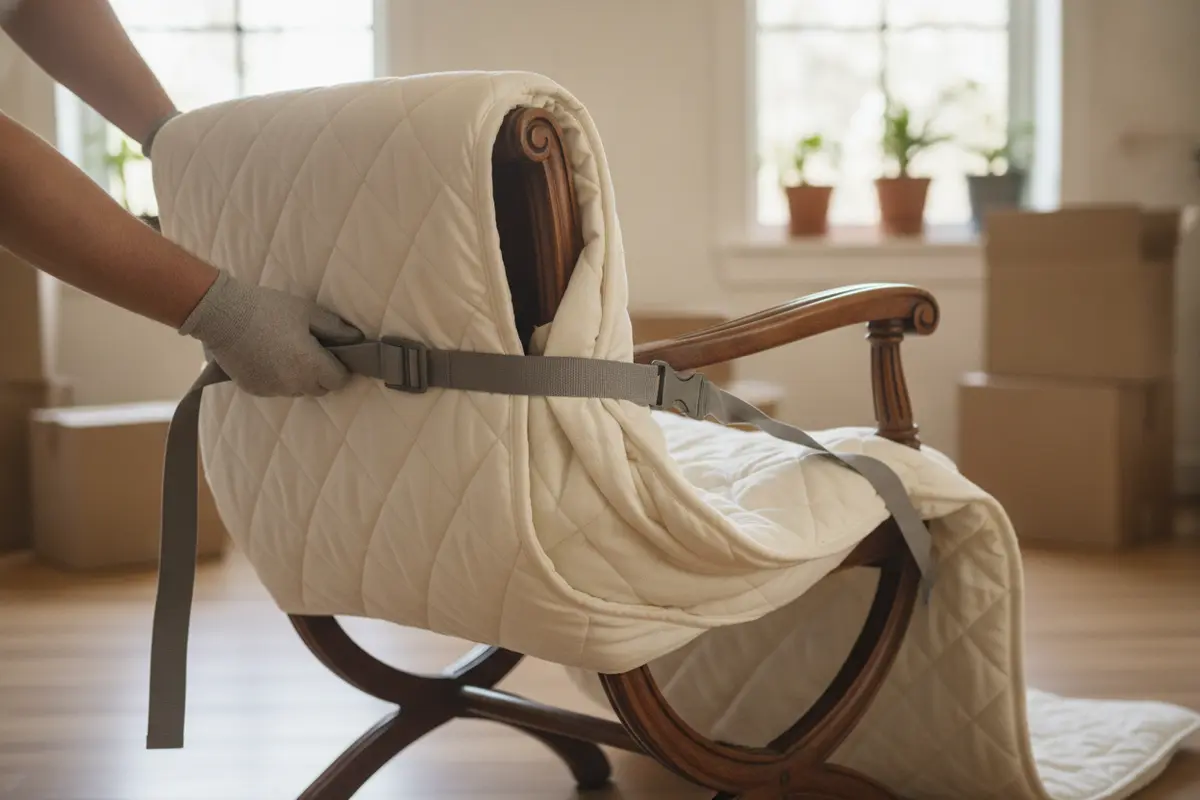
Do not apply tape directly to a finished wood surface, a delicate veneer, or upholstery. Do not lift a piece by a fragile projection or assume a loose joint will support its weight. Tell the crew what you have observed and follow the agreed handling plan. If you are considering professional preparation, review the company’s packing services and discuss the specific item before deciding what work is appropriate.
Specialty handling is not automatically needed for every old object. A sturdy piece may be moved as part of a household shipment with suitable protection, while an unusually fragile or awkward piece might call for more discussion. For example, a small side table with no loose components has a different preparation checklist from a large cabinet with glass doors and removable shelves. Describe the construction and ask the mover to explain the plan in plain terms.
It may also help to ask how the crew will protect nearby walls, door frames, and floors while moving a large piece through a tight space. The goal is to plan the route and handling before the item is lifted, rather than discovering a turn or obstacle midway through the move.
What should you know about valuation and an antique’s worth?
Market value, sentimental value, an appraisal, and moving valuation protection are not interchangeable. An appraisal is an independent opinion about an item’s value for a purpose such as documentation. The mover’s estimate addresses the planned transportation services. Valuation protection concerns the terms that apply to the move and should be explained by the moving company.
If the antique has a high monetary or personal value, raise that concern before booking. Ask which options are available, what they cover, what limits or conditions apply, and what documentation is useful. Read the applicable paperwork and ask questions about any part you do not understand. Do not assume that an appraisal alone changes the mover’s terms or that a declared value guarantees reimbursement at market value.
Keep a copy of photographs, a written description, and any appraisal or ownership records you already have. If you have questions about your separate homeowners or renters policy, ask your insurer what it covers during a move. The mover and insurer can explain their respective terms; neither conversation replaces the other.
Does the move type change the cost?
Yes. A local move in Wilmington, Newark, Middletown, Hockessin, New Castle, Bear, or Townsend is generally priced by hourly rates. Access and the time required for the move can be part of the planning discussion. Long-distance and interstate moving pricing is based on weight and mileage, alongside the services included in the estimate. Make clear whether the antique travels with the rest of your household goods or requires a separate arrangement.
Delaware Moving & Storage is a family-owned relocation and storage company serving the tri-state area from northern Delaware for more than 42 years. It has been an official Wheaton World Wide Moving agent since 1999, supporting long-distance and interstate relocation capability. Confirm availability for a specific address and route. You can review local moving services, read about planning an interstate move, or learn about the Wheaton agent relationship.
For any move, the item description and access information should be consistent across the estimate and inventory. If you are moving from an apartment, tell the mover about elevator access, loading rules, and any time window set by the building. For a house, note steps, narrow entries, or a long driveway. A survey can help identify questions that are easy to miss in a brief phone or online description.
Should storage be part of the plan?
Storage may be useful if the new home is not ready, the delivery date is uncertain, or the item needs to wait while other parts of the move are completed. Ask how the antique will be prepared and inventoried, whether the proposed storage arrangement can accommodate it, and whether pickup, storage, and later delivery are each included or listed separately.
Consider the whole sequence: where the item will be collected, how it will be protected, how long it may be held, and how it will reach the final address. If the timeline or destination changes, ask how that affects the estimate and service plan. Review the company’s storage options and confirm that the arrangement is suitable for the particular piece.
Do not leave valuables, keys, personal papers, or small irreplaceable objects inside furniture for transport or storage. Keep detachable pieces and documentation organized, labeled, and accounted for. If you are deciding between direct delivery and storage, ask for both arrangements to be described clearly so you can compare the scope and understand which services each includes.
What questions should you ask before booking?
Use these questions to make the estimate discussion specific and to check that everyone understands the plan:
- Does the written inventory identify this antique and note its condition?
- Who is responsible for packing it, and what preparation is included?
- How will removable shelves, glass, or other components be handled?
- Which access conditions did the survey include at pickup and delivery?
- Is the item included in the household shipment or treated as a separate move?
- What valuation protection options are available, and where can I review their terms?
- If storage may be needed, are storage and later delivery included or itemized separately?
- What changes to the inventory, access, or timing could affect the estimate?
Keep answers with the written estimate and update the mover if a material detail changes. This helps you compare proposals consistently and provides a shared reference as moving day approaches. For general preparation, see the company’s moving guide, move preparation information, and steps for preparing for movers.
Frequently asked questions
Is an antique always more expensive to move than ordinary furniture?
No. Age alone does not determine the cost. The estimate depends on the item’s size, condition, packing and handling needs, access, distance, and the services requested. Share specific details so the plan reflects the piece rather than a broad label.
Can a mover estimate the cost from a photograph?
Photographs help show construction and condition, but they may not reveal dimensions, weight, stairs, building restrictions, or the full route. Provide photos along with measurements and access details. A physical or virtual survey gives the mover more information to prepare a detailed estimate.
Should I have an antique appraised before moving it?
An appraisal may help document an item’s value, but it is separate from the moving estimate and does not itself establish the mover’s valuation terms. Ask an appraiser about documentation if you need an independent valuation, and ask the mover to explain the available protection options.
Can I move an antique into storage and deliver it later?
That may be possible depending on the item and the storage arrangement. Confirm in advance that it can be accommodated, how it will be protected and inventoried, and whether storage and later delivery appear in the estimate as included or separate services.
What if I do not know the antique’s weight or materials?
Do not guess. Share what you can measure and photograph, and note what remains unknown. The survey can help identify what additional information the mover needs to plan the handling and estimate.
Make the estimate specific to the piece
Before requesting an estimate, gather dimensions, photographs, condition notes, pickup and delivery details, and information about stairs, elevators, parking, or storage. Delaware Moving & Storage uses a physical or virtual survey to understand the move and prepare a detailed estimate. For a general overview of its moving tips and moving services, review the linked planning resources, then ask about the handling plan for your specific antique.
Request a free moving estimate
With the item’s details, route, and service scope documented in advance, you can compare estimates and know what questions to resolve before moving day.