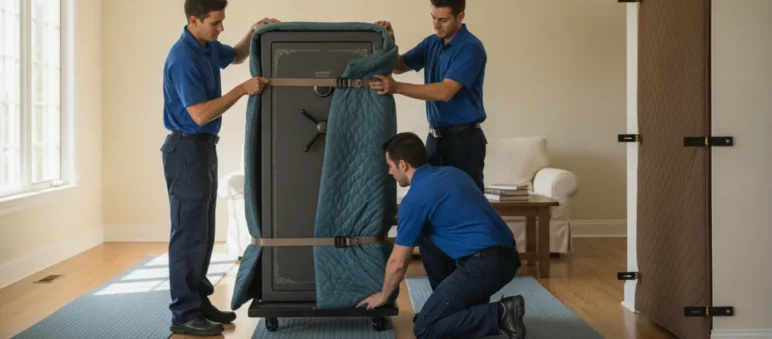
A gun safe can look stationary until you account for its weight, narrow doorways, stairs, flooring, and the turns required to reach its destination. Moving one safely takes more than strength. It requires route evaluation, home protection, appropriate equipment, and enough trained crew members for the conditions.
The safest choice is to hire qualified gun safe movers after sharing the safe’s dimensions, estimated weight, contents, access points, stairs, and desired placement. A physical or virtual survey helps the moving company prepare a detailed estimate and a plan that fits your home, rather than relying on a blind assumption.
Before requesting an estimate, remove firearm and ammunition contents and handle them separately in accordance with applicable laws. Then gather clear information about the safe and both locations. Understanding why this item demands more planning than ordinary furniture will help you ask better questions and make practical decisions from the first conversation.
Why Do Gun Safe Moves Need More Planning Than Ordinary Furniture?
Gun safe moves require an access assessment, a planned route, and qualified help. The safe’s weight, shape, and center of gravity can create risks that ordinary furniture does not.
A gun safe is not simply a large cabinet. It may be tall, difficult to grip, and concentrated with weight in a compact footprint. One specialty-moving source describes gun safes ranging from 200 to 1,500 pounds, but that is an illustrative competitor-researched range, not a universal limit for every model. The manufacturer’s specifications, actual contents, and site conditions should determine the plan.
That plan begins before moving day. A qualified crew needs to understand the safe’s dimensions and weight, then review doorways, halls, turns, stairs, flooring, thresholds, and the final placement area. A route that looks open from a distance may not provide enough clearance for a tall, awkward object. Floors and door frames also need consideration before equipment and personnel are selected.
There is a safety reason to take this assessment seriously. The CDC and NIOSH Revised NIOSH Lifting Equation evaluates back-injury risk in two-handed lifting tasks. It considers object weight, hand position, travel distance, frequency, duration, and grip quality. It can be used for single or multiple lifting tasks, with the goal of reducing low-back injuries in workers. Read the CDC/NIOSH lifting guidance for the source methodology.
OSHA treats manual and mechanical material movement as distinct safety topics and warns that improper handling and storage of materials can result in costly injuries. That reinforces why homeowners should not improvise lifting or rigging methods. OSHA’s material-handling guidance explains the broader workplace safety considerations.
Professional planning also protects the property and the safe itself. Delaware Moving & Storage can review specialty requirements as part of its specialty item moving services, helping clarify access, crew needs, protection, and placement before work begins.
Request an estimate for your gun safe move.
What Should You Measure Before Hiring Gun Safe Movers?
Short answer: Gather the safe’s documented dimensions and approximate weight, then describe the complete path from its current position to its destination. Include door swings, stairs, turns, floor changes, elevators, narrow openings, and anything that could obstruct the route. This information helps qualified gun safe movers evaluate access and prepare an appropriate plan. Do not attempt to lift, tip, or move the safe yourself.
Before the survey, walk the route without moving the safe and record what you can safely observe. A physical or virtual survey can then document the inventory and access details needed for a more accurate, detailed estimate. Learn more about the process in this moving survey and estimate guide.
- Record the safe’s size and approximate weight. Check the manufacturer documentation, model information, or original specifications for the exterior height, width, depth, and approximate weight. Measure any part that extends beyond the main cabinet, such as handles or hinges. If the documentation is unavailable, tell the mover what you know and provide clear photos. Do not guess at a precise weight or remove components to make the safe lighter.
- Note the door and hallway access. Measure the relevant doorways and hallways, and note the direction each door opens. Include the safe’s starting doorway, interior doors, exterior doors, gates, and any especially tight passage. Mention thresholds, baseboards, railings, and turns that could reduce usable clearance.
- Map stairs, floors, and elevators. Count the steps and identify landings, stair turns, ramps, split levels, and changes in flooring. For elevators, record the doorway and interior dimensions, weight information posted by the building, and any booking or access requirements. Flag upper-floor or basement locations so the crew can assess the route rather than making assumptions.
- Describe the destination and final placement. Identify the room, the exact area where you want the safe placed, and the approach to that location. Note the floor surface, nearby walls, corners, cabinets, and other fixed features. If the safe will move to another property, gather the same information at the destination.
- Clear and report obstacles. Identify furniture, stored boxes, rugs, low fixtures, parked vehicles, landscaping, or uneven surfaces that may affect access. Do not create a moving path by handling the safe. Instead, remove ordinary loose items where practical and tell the moving company what remains so the crew can plan protection and equipment.
Send these details before the survey, along with photos of the safe, route, stairs, tight turns, and destination. Honest measurements are more useful than optimistic estimates. The crew can confirm the plan, discuss access concerns, and explain what preparation is appropriate without asking you to perform a hazardous move.
How Do Gun Safe Movers Protect Floors, Doors, and the Safe?
Short answer: Professional movers protect the route before the safe moves, use suitable handling equipment and enough crew members. Control weight distribution, confirm final placement, and clean the work area afterward.
A gun safe is both heavy and awkward, so protection starts with the home rather than the truck. The crew should review the planned path, identify vulnerable flooring and doorways, and discuss tight turns, thresholds, stairs, or other access concerns before work begins. That advance planning helps the team choose an appropriate process without asking an untrained homeowner to improvise a lift or rigging method.
Protecting floors, doors, and walls
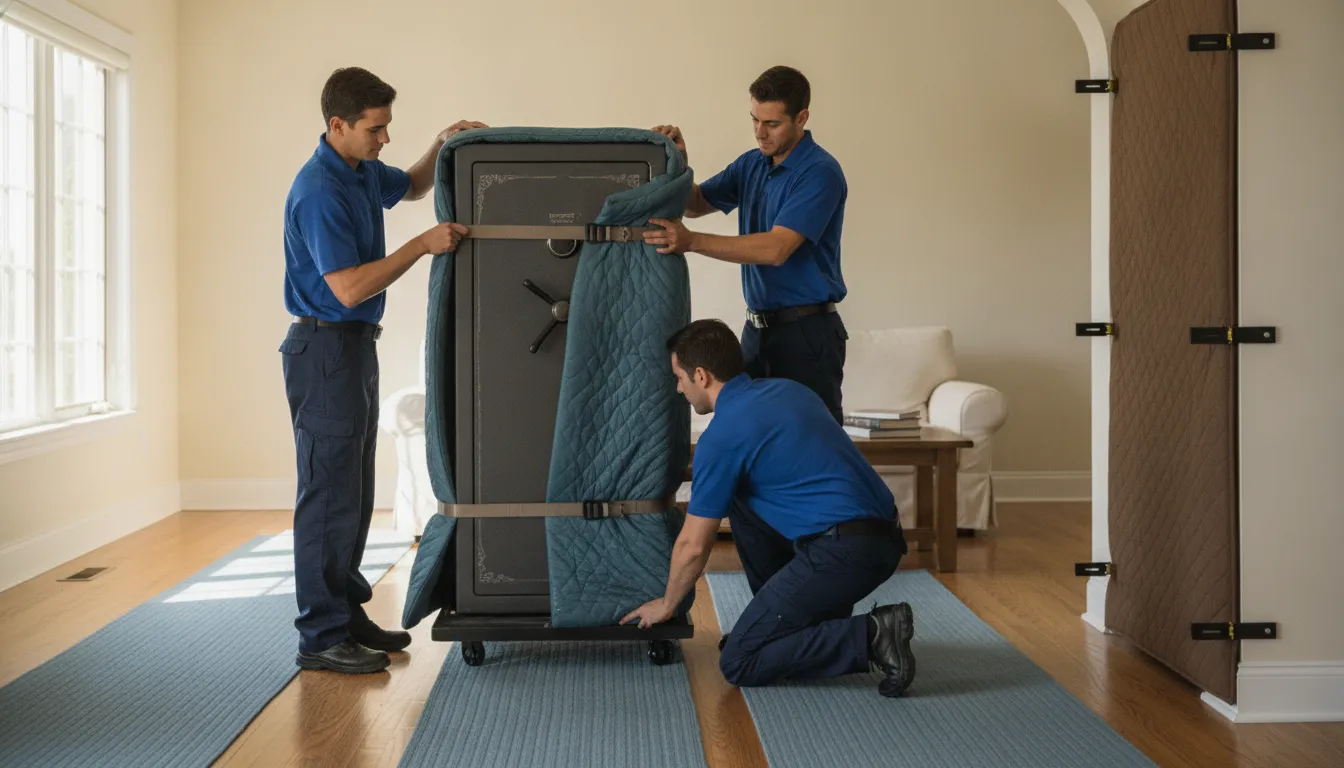
Door and floor protection materials are part of Delaware Moving & Storage’s moving process. Depending on the route and the home’s surfaces, that may include floor runners, pads, corner protection, and protective coverings around doorways. Clean padding and wrapping can also help protect the safe’s finish while reducing the chance of contact with walls, trim, or other furnishings.
Protection is not only about avoiding visible scratches. A heavy item can concentrate pressure in a small area, especially when it changes direction or crosses a threshold. The crew should keep the route controlled, protect the surfaces most exposed to contact, and monitor the move instead of treating each doorway as an afterthought.
Using equipment and staffing that fit the move
Delaware Moving & Storage’s local operations include hand trucks, four-wheel dollies, professional moving trucks, and furniture pads. The right equipment depends on the safe, the building, the route, and the destination. A survey helps the company understand those conditions before the estimate is prepared, rather than relying on a blind assumption about access.
Local moves use at least two crew members, with staffing scaled to the size of the move. That supports communication and coordinated handling while the team manages the safe’s position and the surrounding space. Careful loading and weight distribution matter during transport as well. At the destination, movers place the safe according to the customer’s direction and leave the work area clean.
Request a moving estimate for your gun safe and access conditions.
Before scheduling, share the safe’s approximate dimensions and weight, the starting and ending locations, floor types, doorway widths, stairs or elevators, and the intended placement area. The more complete the access picture, the more useful the plan can be.
| Detail. | Confirm. |
|---|---|
| Safe. | Size and weight. |
| Route. | Doors, stairs, and turns. |
| Protection. | Floors, doors, and padding. |
| Destination. | Room and placement. |
What Happens When Gun Safe Movers Arrive?
Short answer: The crew confirms the agreed plan, protects the route, prepares the safe for handling. Moves it with appropriate staffing and equipment, places it where you direct, and cleans the work area. Your role is to provide accurate information, clear access, and a final placement decision. The physical handling and movement plan remain crew-controlled.
- They confirm the plan. Before work begins, the crew reviews the safe’s location, destination, route, access conditions, and any concerns identified during the estimate or survey. Delaware Moving & Storage emphasizes pre-planning and monitoring moves from start to finish. If conditions differ from what was described, pause for a revised plan rather than asking the crew to improvise.
- They protect the premises. The crew prepares doors, floors, corners, and other exposed areas along the route. Door and floor protection materials, furniture pads, and other protective supplies help reduce the chance of avoidable contact damage. The exact protection used depends on the home’s layout, surfaces, and the safe’s route.
- They prepare the safe. Gun safe movers assess the item and organize the handling process before loading. This may include confirming that the safe is ready to move and selecting suitable equipment. Homeowners should not attempt to tilt, lift, rig, or disassemble a safe themselves. Instead, tell the crew about unusual access, prior damage, attached components, or concerns about the destination.
- They load with adequate staffing. A safe is an awkward specialty item, not ordinary furniture. Delaware Moving & Storage uses at least two crew members for local moves and scales staffing to the size of the move. The crew controls the loading method, equipment, and weight distribution. Stay clear of the work area and keep children, pets, and other household activity away from the route.
- They transport and place it as directed. The crew completes the move from the origin to the agreed destination, whether that is another home or a different room. At delivery, explain the desired orientation and location before placement. Ask in advance whether leveling, bolting, elevation, or other installation-related services are included, because those services should be confirmed rather than assumed.
- They inspect the area and clean up. After placement, the crew checks the work area, removes protective materials and moving debris, and leaves the space orderly. Before the crew departs, review the safe’s position and raise any immediate concerns. A clear final walkthrough helps confirm that the placement matches your instructions.
What Should You Ask About Firearms, Ammunition, and Valuation?
Answer: Before scheduling, confirm that the firearms will be unloaded, ammunition will be handled separately, and everyone understands who is responsible for the contents. Then ask how the mover will document the safe, what valuation protection options apply, and which services are included in the estimate.
This is practical safety information, not legal advice. Firearm owners should follow all applicable federal, state, and local rules. The U.S. Department of Justice recommends unloading each firearm before storage. It also recommends placing unloaded firearms in a locked safe, vault, cabinet, or case and keeping ammunition locked in a secure location away from the firearm. See the Department of Justice firearm safety guidance for the source recommendations.
As an additional safety reference, Colorado public-health guidance explains that secure storage involves a safe, lock box, cable lock, or trigger lock. It also notes that simply hiding a firearm or placing it out of reach is not the same as secure storage. Its most secure-storage recommendation is to keep firearms locked and unloaded, with ammunition stored separately: Colorado secure firearm storage guidance. Your mover can discuss the moving plan, but should not interpret firearm laws for you.
Questions to ask the mover
- Should I remove all firearms and ammunition before the crew arrives, and how should I keep them separate during the move?
- What information do you need about the safe, including its approximate weight, dimensions, access route, stairs, doors, and destination?
- Will the estimate account for bulky items, additional services, mileage, and the shipment weight if this is a long-distance move?
- What valuation protection options are available, and what do they cover or exclude?
- Will the crew confirm the final placement and document any condition concerns before and after the move?
Estimate factors can include weight, mileage, bulky items, additional services, and selected valuation protection, particularly for long-distance relocation. A physical or virtual survey helps the company create a detailed estimate instead of relying on a blind guess. Review valuation protection options with the moving representative, and ask for clear written terms before moving day.
Can Gun Safe Movers Handle Storage or Long-Distance Relocation?
Yes, a gun safe may be included in a storage or long-distance move, but feasibility depends on the safe, the route, access conditions, and the destination. A physical or virtual survey should confirm the plan before scheduling.
Local and long-distance moves are not identical. A local move might involve relocating a safe from one room to another, from a home to a new home, or from a residence into temporary storage. A longer relocation adds shipment weight, mileage, bulky-item handling, additional services, and valuation-protection choices to the estimate. Delaware Moving & Storage can review those details through its long-distance moving services and explain which parts of the move need special planning.
For a tri-state move, ask whether the company serves both the origin and destination, how the safe will be handled during transfer, and who will coordinate delivery placement. Delaware Moving & Storage serves communities throughout northern Delaware, wider Delaware, nearby Pennsylvania, and Maryland. Its long-distance capability also extends through its status as an official Wheaton World Wide Moving agent since 1999. Service area and feasibility still depend on the survey, especially when the destination includes stairs, narrow access, an elevator, or unusual flooring.
What should you ask about storage?
Confirm whether the safe can be accepted into the selected facility, how it will be moved into storage, and what delivery or retrieval arrangements apply later. Delaware Moving & Storage describes a storage operation with more than 40,000 square feet of warehouse and office space. Five loading docks, 24-foot clearance, and a 24-hour central alarm system. Those are facility features, not a guarantee that every safe or storage request is suitable, so provide accurate dimensions, weight, photographs, and access information.
Before the survey, identify the preferred destination location and explain whether the safe needs to remain in storage temporarily or continue directly to a new residence. Ask the crew to confirm placement expectations, protection measures, timing, and valuation options in writing. Clear answers help prevent a last-minute change when the move crosses state lines or the safe requires a more detailed logistics plan.
Frequently Asked Questions
Will movers move gun safes?
Yes, specialty movers may handle gun safes as heavy, awkward items rather than ordinary furniture. The crew should review the safe, route, access points, floors, and placement plan before moving day, then confirm the equipment and staffing required. Ask what parts of the move are included, including loading, transport, unloading, and final placement.
Do gun safe movers move safes up or down stairs?
Stairs are not an automatic yes or no. The answer depends on the safe’s size and weight, stair layout, landing space, floor conditions, doorways, and available equipment. Share clear photos and measurements during the survey, and do not assume a crew can safely move the safe until the access route has been assessed.
Do I need to empty my gun safe before the movers arrive?
Yes. Remove firearms, ammunition, valuables, and loose contents before the move. The U.S. Department of Justice recommends unloading firearms before storage and keeping ammunition locked in a secure location away from firearms. Follow all applicable federal, state, and local laws, and ask the mover how they want the empty safe prepared.
How can I get an estimate without knowing the price upfront?
Request a physical or virtual moving survey. The survey can document the safe’s dimensions, weight, room locations, access details, route, and requested placement so the company can prepare a detailed estimate. For long-distance moves, factors can include weight, mileage, additional services, bulky items, and selected valuation protection. A survey is more useful than guessing from a generic price range.
What should I ask when hiring gun safe movers?
Ask whether the crew regularly handles specialty items, how they evaluate stairs and tight access. What equipment and home protections they use, how many movers are planned, and what placement or cleanup services are included. Also ask about valuation protection, scheduling, and any work that is excluded. Written answers help prevent surprises on moving day.
Get Started With a Gun Safe Moving Estimate
A safe move deserves a clear plan for access, protection, placement, and the services your home requires. Delaware Moving & Storage can review the details with you before moving day so the estimate reflects the actual project. To request a moving estimate for your gun safe move, request an in-home estimate and share the safe’s location, route, and destination. The more details you provide, the better the crew can prepare.