
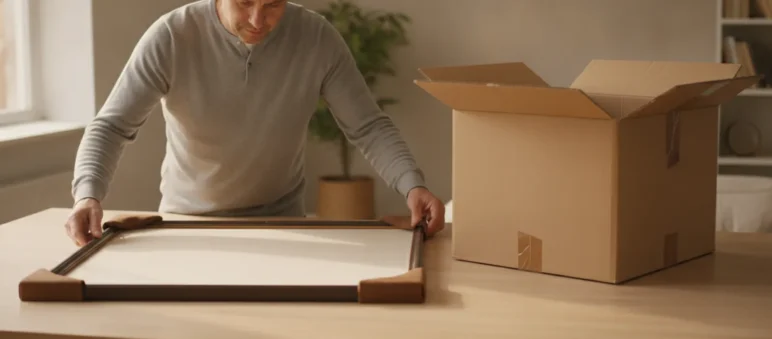
Knowing how to store paintings starts with preventing contact, pressure, and abrupt changes in conditions. Whether you are between homes, renovating, or clearing a room, prepare each piece before moving it into a box or storage area. Framed art, glazed work, and unframed canvas need different protection, so begin with the painting itself rather than with a box.
Request a moving or storage estimate
What should you check before packing a painting?
Inspect the front, back, frame, corners, and hanging hardware in good light. Note loose joints, cracked glass, scratches, flaking or raised paint, a sagging canvas, warped stretcher bars, tears, and signs of moisture. Do not press, rub, or wipe the painted surface to test it. If you see unstable paint, tackiness, visible mold, or fresh damage, pause and ask a paintings conservator for handling advice. Packing may worsen an existing condition.
Photograph the front and back, along with any existing marks. Record a short identifying description, full outside dimensions, frame details if known, and condition notes. Keep the record away from the artwork, and save a copy separately from the storage area. If you have several pieces, give each one an inventory number and put that number on the package, not on the frame or canvas.
Measure the widest and tallest points, including frame projections and hardware. Measure again before buying a carton. An undersized box can press on the frame; a very large box can let the work slide unless you add stable cushioning. Note which pieces are too large to move through doorways or stair turns safely. Plan the route before the lifting begins.
How do framed and unframed paintings differ?
Glass can break, decorative frames can snag, and an exposed painted surface can be damaged by direct contact. Choose packing steps for the construction and condition of each piece. If a painting is unusually valuable, large, fragile, or difficult to handle, get professional advice rather than experimenting with materials.
| Type of painting | Preparation to consider | Storage priority |
|---|---|---|
| Framed work with glass | Secure loose hardware, protect corners, and add a rigid face shield. | Keep upright and prevent pressure on the glazing. |
| Framed canvas without glass | Protect frame corners and use a cover that cannot touch the painted face. | Keep other objects and wrap away from the canvas. |
| Unframed canvas | Use a suitable non-abrasive protective layer and rigid support, selected for the surface. | Support the full work; do not stack anything on it. |
| Recently painted or damaged work | Ask a paintings conservator about handling and packing before wrapping. | Do not assume ordinary household packing is suitable. |
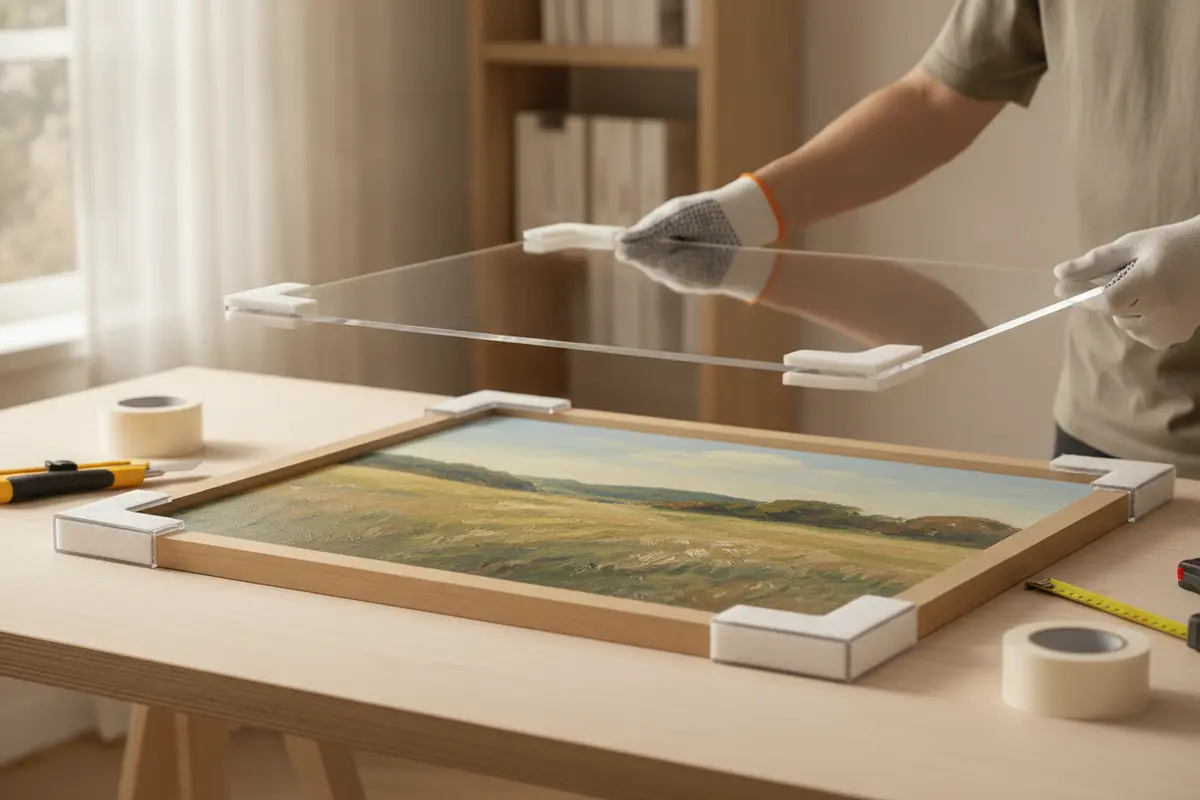
For glazed art, some people use removable painter’s tape in a light X across the glass to help hold fragments if breakage occurs. Tape does not prevent breakage and may leave residue or damage some glazing. If you are unsure whether it is appropriate, skip it and use a rigid face panel instead. Secure loose hanging wire or fittings so they cannot scratch the back or another item.
For unglazed work, never put bubble wrap, foam, plastic, paper, or tape directly against the paint. A smooth barrier and rigid outer cover may help, but the right materials depend on the paint and its condition. If the surface is tacky, raised, powdery, or unfamiliar, consult a conservator before packing.
How should you wrap and box a painting?
Prepare a clean work surface and keep food, drinks, plants, and dusty supplies away. Wash and dry your hands before handling art. Lift framed pieces by their sides, not by a hanging wire or decorative ornament. Use two people for a large work so it stays supported. Choose a sturdy art carton or box that fits, with room for cushioning around the edges.
- Secure loose parts. Remove detachable hardware only if you can do it safely. Place it in a labeled bag kept with the inventory, not taped to the artwork. Otherwise secure it so it cannot shift or scratch.
- Protect the corners. Fit guards that do not press against fragile frame details or painted edges. Check they remain in place when the frame is lifted gently.
- Shield the face. Add a rigid panel or other suitable face protector. It must not touch unglazed paint. Do not stick adhesive to the art, frame finish, or canvas.
- Cover the package. Use a clean outer covering around the piece, not stretched tightly across the face. Do not seal a damp or dusty painting inside plastic. The goal is protection from dirt and handling without trapping moisture or adding pressure.
- Fit and cushion the carton. Place the work so it cannot slide. Cushion its sides and corners, then gently move the carton a small amount to check for shifting. Fill gaps with stable padding, not loose items that can press into the frame.
- Close and label it. Secure the box and mark its orientation and fragile contents. A label is a reminder for handlers, not a substitute for a fitted carton and internal support.
Do not stack heavy boxes on artwork. Keep frame edges from rubbing together. For multiple pieces, use firm dividers or enough separation to prevent packages from tipping or pressing against one another. A blanket or towel alone is not dependable protection: fabric can shift, snag hardware, and allow pressure to reach the surface.
For general household packing, see the company’s packing-with-care guidance and its advice on packing books and belongings. These cover general handling, not the special requirements of paintings.
How can you move paintings to storage safely?
Think about the trip as well as the storage period. Protect packages from rain and direct sun while carrying them. Avoid leaving a painting unattended in a vehicle where heat or cold can build up. Secure boxes so they cannot slide or fall, and keep them away from liquids, tools, and heavy items. If a piece is too wide for a doorway or stairwell, stop and plan the route. Measure turns and clear obstacles rather than forcing or sharply tilting the frame.
Keep artwork separate from furniture, cleaning products, and belongings that may leak or shed dust. When loading several pieces, put them where they will stay supported and accessible without shifting other cargo. Do not assume a fragile label will keep a package upright during transport; use physical support. If you need help planning a household move, the move preparation guide can help organize the broader checklist.
How can you plan a painting storage project step by step?
Work from a list instead of packing whatever is closest first. Start by grouping the paintings by size, framing, glazing, and condition. This makes it easier to choose cartons and identify pieces that should not be handled with ordinary household materials. For example, a small glazed print in a stable frame may need a different carton from a large unglazed canvas with a raised surface. Do not treat the fact that both are called paintings as proof that one packing method fits both.
Next, decide which pieces need special attention before the packing day. Mark the inventory entry, not the art itself, if a work is oversized, has loose frame joints, or cannot safely be lifted by one person. If a painting has a fresh surface, visible damage, an unusual construction, or uncertain stability, set it aside and ask a conservator before proceeding. This avoids having a helper discover a problem while holding the work in a narrow hallway.
Gather supplies only after measuring each piece. A simple planning sheet can include outside width and height, depth, whether glass is present, the number of people needed to lift, the carton size, and its intended position in storage. Measure doorways, stair turns, and the path to the vehicle as well. A carton that fits the painting but cannot pass through a landing or doorway is not a workable choice. Clear rugs, shoes, and other trip hazards before carrying anything.
- Prepare the route. Open doors, move furniture and boxes out of the way, and agree on where each package will be set down. Keep children and pets outside the carrying path.
- Prepare the destination. Choose a dry area, clear a stable platform, and make sure the package can remain upright without leaning on other belongings.
- Pack one piece at a time. Complete the face protection, corner protection, cushioning, and label before starting the next painting. This reduces mix-ups and makes it easier to match each package with its inventory record.
- Record the final position. Note which wall or area contains the numbered package. Keep the map with the inventory and not inside a carton that may be hard to reach.
Use a final check before leaving the room: Is the carton dry and secure? Can the work shift inside? Does any covering touch unglazed paint? Is the box marked with its top and handling direction? Is the package supported against tipping? Fix a problem while the package is still easy to reach, rather than after stacking surrounding belongings around it.
What changes for a short gap versus long-term storage?
A painting held for a few days during a move still needs protection from impacts, weather, and contact. Short duration is not a reason to leave it beside a radiator, in a sunny vehicle, or leaning loosely in a busy room. If the delay is brief, prioritize a safe route, a protected package, and a dry indoor place where people will not bump it. Keep it away from the work zone if renovation dust, paint, or cleaning products are present.
For a longer period, placement and recordkeeping matter more because the package may be left undisturbed for months. Confirm how the site controls access, monitors its conditions if applicable, and responds to leaks or other problems. Ask what you may inspect and how to arrange access without moving other property. Do not treat a claim that a space is secure or climate-controlled as a substitute for asking what those words mean in practice.
Consider a household between homes with three different pieces: a small glazed landscape, a large canvas without glass, and a portrait with a loose corner ornament. The first needs a face shield and protection from breakage; the second needs a barrier that will not touch paint and full support; the third needs its loose part secured or removed safely, with the component recorded. They may travel together, but they should not be packed as though they have identical risks. Keep each carton separate and identifiable, then place them where none can tip into another.
Another practical example is a renovation where the paintings remain in the house. Do not stage cartons next to a contractor’s materials or under a table where equipment may be set down. Choose a room outside the active work area, keep the floor dry, and avoid repeated moves as rooms are cleared. If the work must be carried through a construction zone, check the route for dust and obstacles first and have someone open doors and guide the package.
Where should you place paintings in storage?
Choose a clean, dry location away from direct sunlight, windows, exterior doors, plumbing, and sources of heat. Avoid attics, garages, sheds, damp basements, and spots near radiators or vents when conditions fluctuate. Keep artwork off concrete floors and away from walls that may be affected by condensation or leaks. Elevate boxed pieces on a stable platform, and leave room to inspect and handle them without moving heavy objects.
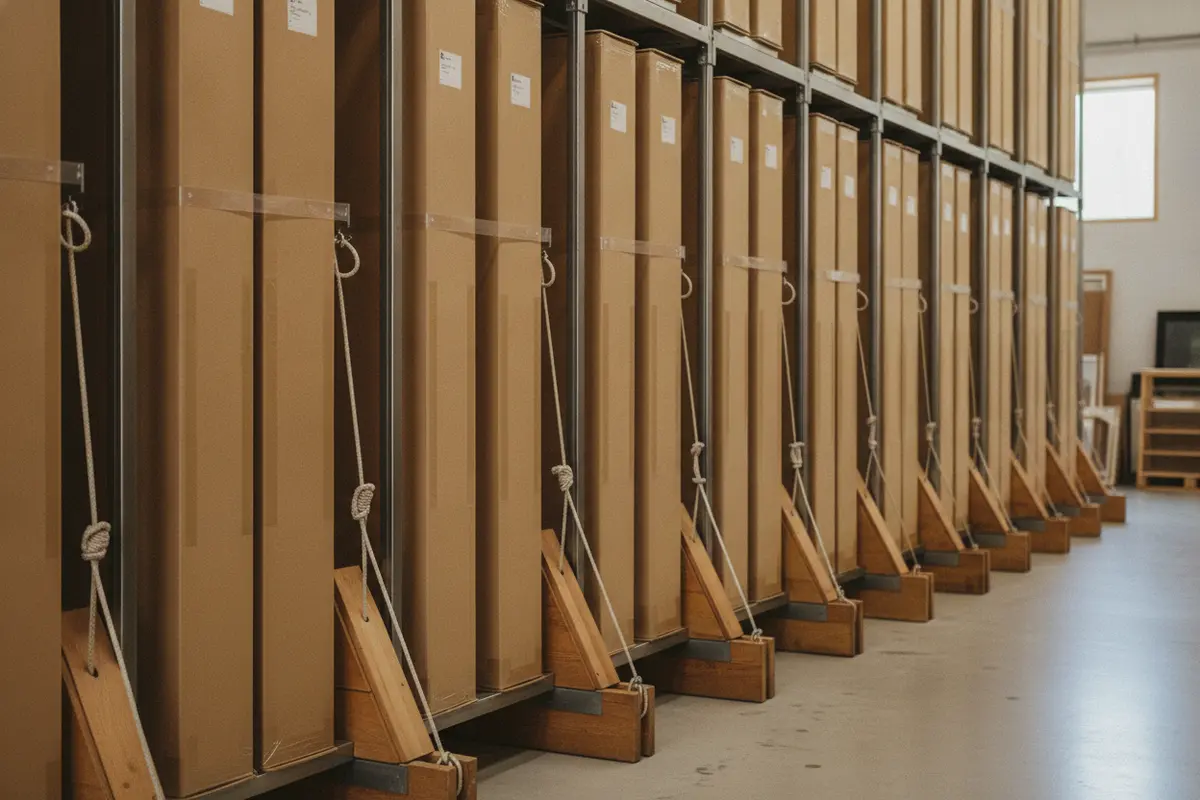
Many framed paintings are stored upright, secured so they cannot tip. Do not leave a frame leaning at a sharp angle or unsecured against a wall, and do not place pieces face-to-face. Keep painted surfaces away from contact. Flat storage may be appropriate only when the full work is supported and nothing is placed on top. Large, fragile, or unusually constructed pieces may need specialist advice about orientation.
Try to avoid moving artwork repeatedly between very different indoor conditions. A room comfortable for people is not automatically suitable for every painting. Ask a storage provider what environmental controls are available, whether conditions are monitored, and how the work is protected from water, pests, dust, and unauthorized handling. Do not assume a particular temperature or humidity range unless it is confirmed. You can review the company’s storage information and ask how a specific arrangement fits your needs.
How do you keep track of paintings in storage?
Create one inventory entry for each work. Include its description, dimensions, frame material if known, condition notes, photographs, packing date, and package label. Keep a copy with your household records. If you store several pieces, number each package and record where it is placed. A useful inventory lets you find one painting without opening boxes or moving others.
Decide who may access the work and whether you will inspect it during a longer storage period. Plan a careful review rather than repeatedly opening and repacking cartons. Use clean hands and a clear work surface. If you notice moisture, insects, a musty smell, new marks, or a change in the paint or frame, document what you see. Do not wipe or treat the work yourself; ask a conservator about next steps.
For valuable art, check your insurance or valuation arrangements and ask what documentation is needed. Do not assume a household policy, mover protection, or storage agreement covers a painting at its full value. Delaware Moving & Storage provides moving service information and an in-home estimate option; ask specific questions about handling, inventory, and coverage before making arrangements.
What should you ask before choosing an art storage option?
Explain whether each work is framed, glazed, large, recently painted, or fragile. Share approximate dimensions and how long you expect to store it. Ask specific questions and keep written answers, especially if you need a certain handling or access arrangement.
- Where will the paintings be kept, and what measures protect them from water, dust, pests, and accidental contact?
- Are environmental conditions monitored? What controls are actually available?
- How will the paintings be positioned and separated from other belongings?
- Who handles the work, and can oversized or delicate pieces receive special handling?
- How can you access the items, and is notice or an appointment required?
- What does the written agreement say about responsibility, declared value, and claims?
Compare answers based on the artwork and the expected storage period. If a provider cannot explain how a piece will be positioned or protected, ask for clarification before packing or reserving space. If mobile storage is under consideration, review the company’s mobile storage container information and ask what arrangement is suitable; do not assume all options provide the same environment or handling.
When should you ask a paintings conservator for help?
Seek advice before packing if paint is flaking, powdery, sticky, or lifting; if canvas is torn or distorted; if mold is visible or a musty odor persists; or if glass or frame details are unstable. Recently painted work also deserves caution. Avoid cleaning, spraying, taping the painted face, or attempting repairs before receiving guidance.
The American Institute for Conservation is a professional conservation organization with resources for finding conservation help. A conservator can assess the materials and condition and recommend handling for that specific piece. This is especially useful when the artwork has financial or personal value that would be difficult to replace.
Frequently asked questions
Can you store a painting in plastic wrap?
Do not let plastic or any other wrap touch the painted surface. Plastic may serve as an outer cover in some situations, but do not trap moisture around a damp work or press plastic against paint. For delicate, tacky, or unglazed art, ask a conservator about appropriate materials first.
Should paintings be stored flat or upright?
Many framed paintings can be stored upright when they are supported and secured against tipping. Flat storage may work only when the entire piece is supported and nothing is stacked on it. Size, frame construction, and surface condition matter, so get advice for unusually large or fragile work.
Can I use a regular moving box?
A regular box may not fit a frame or protect it from pressure and movement. Use a sturdy, correctly sized art carton or suitable box, shield the face and corners, and cushion the edges so the piece cannot slide. A fragile label alone does not prevent rough handling.
How often should I check paintings in storage?
There is no single schedule for every painting or location. Consider the storage period, conditions, and the work’s state. Keep inspections controlled and avoid unnecessary unpacking; document and seek advice if you notice moisture, pests, odor, or a change to the artwork.
Contact Delaware Moving & Storage about an estimate
Plan before you pack
Start with a condition check, select protection that suits the surface, and use a fitted box with stable support. Place paintings away from hazards, keep a clear inventory, and ask questions about handling and conditions before choosing storage. For fragile or valuable work, seek conservator guidance before packing.