
Fine art moving in Cecil County, Maryland, calls for more than a standard room-by-room plan. Paintings, sculpture, antiques, and other valuable belongings may require condition notes, careful measurements. Packing decisions, and a clear plan for stairs, elevators, narrow entries, parking, storage, and delivery access. The right starting point is a conversation about the items and the property before moving day, not a guess based only on the number of rooms.
Request a free estimate for your move.
Fine art movers cecil county md should begin with a physical or virtual survey, an item-by-item discussion of condition and access. And a detailed estimate that accounts for packing, transport, storage timing, and valuation protection choices. Delaware Moving & Storage serves Cecil County, including Elkton, and offers specialty moving for delicate, oversized, heavy, or high-value belongings. A survey helps replace assumptions with a practical moving plan.
Delaware Moving & Storage is family-owned and has served the region for more than 42 years. Its local operations can include pre-move protection, systematic packing and inventory when requested, careful loading, placement, and cleanup. Those details matter because art is affected not only by the distance traveled, but also by how it is prepared, carried, protected, and positioned at each property. The first planning question is why these moves need a different approach from ordinary household furniture.
Why do fine art movers in Cecil County, MD need a different plan?
Answer: Fine art and other high-value belongings can differ widely in size, weight, fragility, shape, and handling needs. A documented, item-specific plan helps the moving team review each piece, anticipate access concerns, select appropriate packing steps, and coordinate equipment before moving day. That level of preparation is different from treating every household item alike.
A framed painting, sculpture, antique, or oversized collectible is not simply another box to load. The piece may have an unusual shape, a delicate surface, substantial weight, or a size that affects doorways, stairs, hallways, and loading access. These details influence how the item should be approached, protected, moved, and placed. A plan gives the crew a shared reference instead of leaving important decisions to the middle of moving day.
Delaware Moving & Storage serves Cecil County, Maryland, including Elkton, and lists specialty moving for fine art, antiques, and other fragile, heavy, oversized, or high-value items. The first useful step is to identify the belongings that need special attention and describe what makes each one different. Note dimensions, approximate weight when known, location in the home, intended destination, and any access issue that could affect the move. For local information, see the company’s moving services in Elkton.
What an item-specific plan should address
Good planning begins with risk assessment. Smithsonian collection-care guidance identifies risk assessment as part of packing design, along with art packing and transport topics such as cushioning selection and application. That does not make a moving company a conservator or appraiser. It does show why the right questions should be asked before materials and equipment are selected.
For each item, the moving discussion can cover the preferred handling points, the surfaces that should not bear pressure. The route through the property, and where the piece will be set down. Paintings, three-dimensional objects, antiques, and heavy items may require different approaches. A written inventory or item list also helps keep the conversation specific and makes it easier to confirm what has been discussed.
Equipment and access matter as well. Smithsonian guidance addresses specialized art-handling equipment and when it may be necessary. The practical question is not whether a move sounds routine, but whether the crew has considered the item’s characteristics and the property’s constraints together. Door widths, turns, floor transitions, stairs, and loading locations should be reviewed early so the plan can be adjusted before the crew arrives.
This preparation supports a calmer move without promising that every risk can be eliminated. Share photographs, dimensions, and access details during the estimate conversation, and ask which packing and handling services fit the items involved. A clear plan helps the homeowner and moving team communicate about the work, timing, and decisions that need to be made for valuable belongings.
How should you document fine art before moving day?
Short answer: Create a simple condition and access record for every piece before packing begins. Photograph each item from several angles, note visible marks or existing damage, record dimensions, and share any handling concerns with the moving team. This gives everyone a common reference without turning a moving inventory into an appraisal.
Start with clear photographs in good light. Capture the front, back, sides, frame, stand, base, hardware, and any areas that already show wear. For a sculpture or other three-dimensional piece, photograph the parts that may be difficult to see once it is wrapped. Keep the original files together in a dated folder, and avoid editing the images in a way that could obscure condition details.
Pair the photographs with a written description. Include the artist or maker if known, the title if applicable, approximate age when known, dimensions. Materials, and any special features such as glass, a fragile frame, loose components, or a hanging system. If you have prior appraisal, gallery, purchase, or restoration records, keep those documents with your personal files and identify which piece they relate to. A mover can use this information to plan the move, but should not be treated as an appraiser or conservator.
- Photograph each side, frame, base, and existing blemish.
- Record dimensions, materials, weight estimates if known, and removable parts.
- Note stairs, elevators, narrow doorways, low clearances, and parking limitations.
- Identify pieces that need special discussion before packing or placement.
Access notes are just as useful as condition notes. Measure the piece and compare it with doorways, hallways, stair turns, elevators, and the planned placement area. Mention narrow entries, steps, uneven surfaces, or limited parking during the planning conversation. These details help the crew consider pre-move protection, loading order, placement, and the practical equipment needed at each address.
For local moves, Delaware Moving & Storage describes operations that can include systematic packing and inventory when requested, along with pre-move protection, careful loading, unloading, placement, and cleanup. Confirm what you want documented and whether the inventory should include packing notes or placement instructions. The company serves Cecil County, including Elkton, so local planning can be coordinated around the specific homes and access conditions involved.
If you are preparing several valuable pieces, this guide can help you prepare valuables for movers. You can also review practical advice to pack fragile artwork safely. Bring your record to the estimate discussion and ask the moving team to review item count. Dimensions, condition, access, packing needs, storage timing, and valuation protection before moving day.
What protection and access details should you plan first?
Answer capsule: Start by matching the protection plan to each piece and the route it will take through the property. Discuss packing scope, cushioning, furniture and surface protection, stairs, elevators, narrow entries, and parking before moving day so the crew can plan the work rather than improvise it.
Decide whether you need full packing, partial packing, or help with only the most fragile pieces. Delaware Moving & Storage describes full and partial packing with professional materials, so your estimate can reflect the level of assistance you actually want. For paintings, framed works, sculpture, and antiques, ask how each item will be cushioned and secured for handling. The Smithsonian identifies packing design, cushioning selection, shock, vibration, and specialized equipment as important art-transit considerations. That guidance is useful for planning questions, but it is not a promise that every move requires conservation-grade packing.
A practical discussion should cover the condition and construction of each item. A delicate frame, projecting element, glass surface, or unstable base may call for a different approach than a compact, sturdy piece. Ask what materials will separate the artwork from other objects and how the crew will limit unnecessary contact during loading and placement. If an item may need custom protection, treat that as a question for the survey rather than assuming a particular crating or conservation service is included.
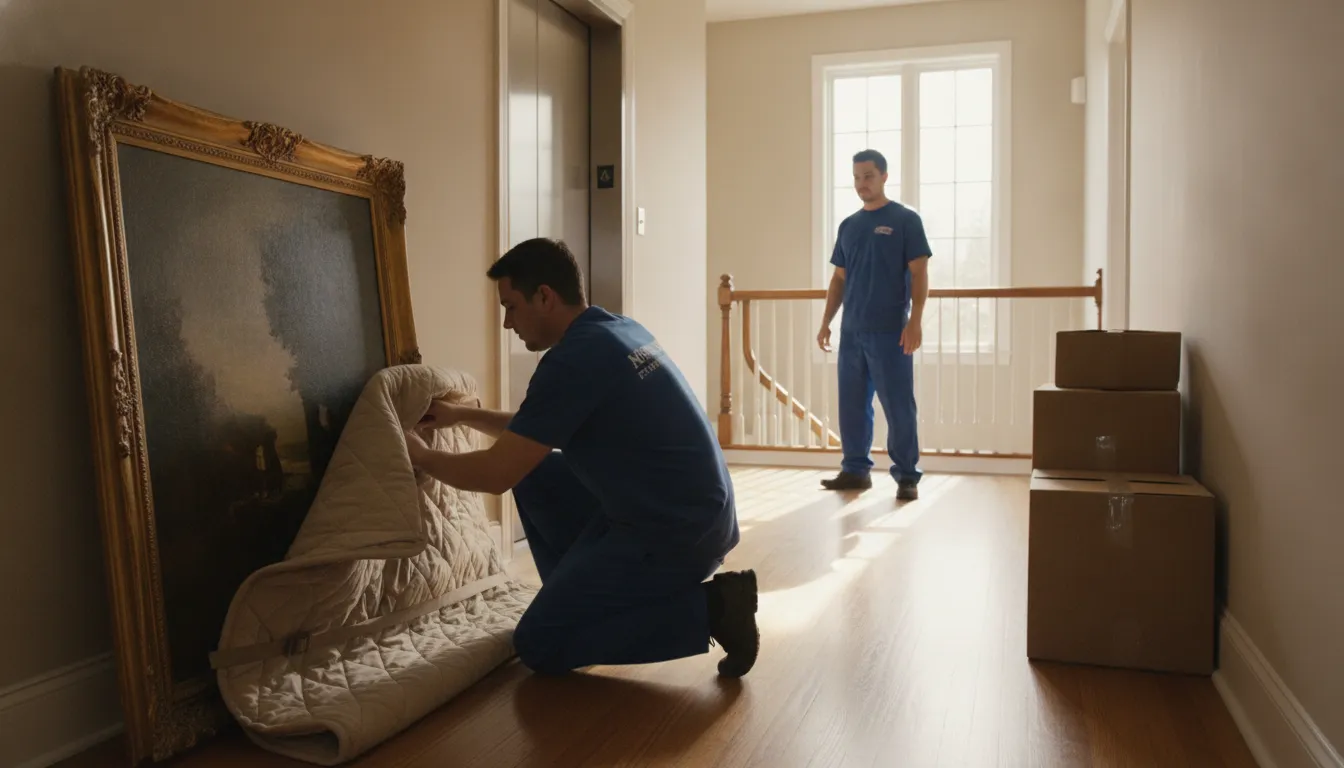
Plan the path from the room to the truck
Access details can affect both safety and the time required. Measure narrow doorways and hallways, note stairs and turns, and identify elevators, loading zones, gates, or uneven paths. For apartment or commercial buildings, confirm reservation requirements, service-elevator dimensions, building hours, and any certificate or parking rules. At a house, clear the route and point out low ceilings, tight landings, delicate flooring, or exterior steps.
Protection is not limited to the artwork. Delaware Moving & Storage lists hand trucks, four-wheel dollies, furniture pads, and professional trucks among its standard equipment. And its service information notes the use of door and floor protection materials. Confirm where pads and surface coverings will be needed, especially around polished floors, painted trim, stair rails, and door thresholds. Parking close to the entrance can also reduce carrying distance, but only after local restrictions and property rules are checked.
Bring these details into the physical or virtual survey, along with dimensions, approximate weights, photos, and the intended placement at delivery. You can also review professional packing services before the conversation. A clear access and protection plan helps the crew prepare the right questions, equipment, and materials for the move.
How do transport and storage work together for valuable pieces?
Answer: Transport and storage should be planned as one sequence. The right approach connects the item inventory, packing requirements, travel schedule, delivery access, and the length of time each piece may remain in storage.
For a local move in Cecil County, the plan may focus on careful pickup, direct delivery, and placement at the new address. A longer relocation requires more coordination. Delaware Moving & Storage describes its long-distance process as including a detailed inventory, weight estimation, professional packing, loading, transit communication, delivery coordination, and unloading. That sequence helps the crew and the customer work from the same information before the shipment leaves.
Inventory is especially useful when a collection includes different sizes, materials, or handling needs. Record each piece, its dimensions, current condition, packing requirement, and intended destination room. This information can support weight estimation and help identify which items need extra access planning. A physical or virtual survey can then give the moving team a clearer view of the shipment and the services involved.
Match the storage period to the move schedule
Storage can bridge the gap when the home is not ready for immediate delivery. A closing date may shift, renovations may not be complete, or access to the new property may be delayed. In other cases, a collector may need a short holding period while rooms are prepared. Delaware Moving & Storage offers both short-term and long-term storage, so the storage conversation should cover the expected duration. Access needs, delivery timing, and any pieces that must remain available.
The company describes its storage facility as having more than 40,000 square feet of warehouse and office space. 24-foot clearance, five loading docks, a 24-hour central alarm system, a Class A rating, and containerized storage systems. These are facility details, not a promise of climate-controlled fine-art storage. Ask specific questions about the storage arrangement that fits your pieces and the planned period.
Before loading, confirm how wrapped or crated pieces will be identified and which items are scheduled for early release. At delivery, confirm the room placement, pathway, elevator or stair access, and any temporary staging area. If the destination is still under renovation, a planned storage release can reduce unnecessary handling and keep the delivery coordinated with the home’s readiness.
For a temporary transition, review these short-term storage between moves considerations. For broader planning, compare the available moving storage options.
| Planning point | Question to confirm |
|---|---|
| Pickup | Which pieces need special access or protection? |
| Storage intake | How will each item be identified and recorded? |
| Release | Which pieces need to remain available? |
| Delivery | Who confirms access and placement timing? |
A written schedule should identify pickup, storage intake, release, delivery, and placement dates, along with who will confirm changes. Clear communication matters when access, renovation, closing, or delivery plans move at different speeds.
What should valuation and estimate discussions cover for fine art movers in Cecil County, MD?
Short answer: A useful valuation and estimate discussion should cover every item, its dimensions and condition. The access at pickup and delivery, packing and storage needs, the route, added services, and the valuation protection you select. A physical or virtual survey gives the mover the information needed to prepare a detailed estimate rather than relying on assumptions.
For fine art movers in Cecil County, MD, begin with a complete inventory. Identify each painting, sculpture, framed piece, antique, or other valuable object. Share the item count, approximate dimensions, weight when known, materials, frame details, and any unusual features. Photographs and notes about existing marks or fragile areas can help create a clear record for the planning conversation. This documentation is not an appraisal, and a mover should not be expected to determine an artwork’s market value.
What should the survey identify?
During a physical or virtual survey, discuss the condition of each piece and how it will be prepared for handling. Ask whether full or partial packing is appropriate, what professional packing materials may be needed, and whether any item requires extra time or specialized planning. Delaware Moving & Storage describes its packing service as available for full or partial packing with professional materials. These choices belong in the estimate so the scope is clear before moving day. Valuation protection options should also be reviewed as part of the service discussion, separate from an appraisal or an insurance promise.
Access details matter just as much as the artwork itself. Note stairs, elevators, narrow halls, low ceilings, tight turns, door widths, loading areas, parking limitations, and the location of each piece within the home. Mention whether a piece must be removed from a wall, moved through a finished room, or placed in a particular location at delivery. Item dimensions and access information help the crew plan equipment, labor, and protective measures. The company lists professional trucks, hand trucks, four-wheel dollies, furniture pads, and door and floor protection among its standard moving resources.
Which services and timing should be included?
For a longer-distance move, ask how inventory, weight estimation, packing, transit communication, delivery coordination, and unloading will be handled. Discuss the route, delivery timing, storage needs, bulky or unusually shaped items, and any added services before accepting the estimate. Storage may be relevant when a closing, renovation, access issue, or delivery schedule creates a gap between locations. A detailed survey should capture those decisions and the selected valuation protection so the estimate reflects the move you are actually planning.
To start the conversation, request an in-home estimate and ask about a physical or virtual survey. Bring your inventory, dimensions, condition notes, access concerns, packing questions, storage timeline, route details, and valuation questions to that discussion. The goal is a transparent, well-defined scope with no important assumptions left unaddressed.
How do you choose fine art movers in Cecil County, MD?
Answer: Choose a mover that treats fine art as a planned specialty move, not as ordinary household furniture. Ask how the team will survey each piece, document condition, handle access challenges, protect the artwork, communicate during transit, and discuss storage and valuation. Local knowledge matters, but the plan should be specific to your collection.
Start with the survey conversation. A prospective mover should ask for more than a room count. Be ready to discuss the number and type of pieces, approximate dimensions, frames, pedestals, glass, current condition, and any handling concerns. The mover should also ask about stairs, elevators, narrow hallways, door widths, parking, loading areas, and the placement point at the destination. These details help reveal whether the estimate and handling plan reflect the actual move.
Pay attention to how clearly the company communicates. You should be able to identify who will answer questions, what will happen on moving day, how updates will be shared, and when delivery details will be confirmed. Ask the mover to explain how the crew will protect the home, move each piece through access points, and keep the inventory connected to the right item. If an answer is vague, ask for the assumption behind it before booking.
Storage and valuation deserve their own discussion. If closing dates, renovations, or access timing could separate pickup from delivery. Ask what storage arrangements are available and how the artwork will be identified while it is held. Discuss valuation protection in plain language, including what choices you need to make and what information the mover needs from you. A moving company should not act as your appraiser, so keep any independent appraisal or conservation questions with the appropriate professional.
Local relevance is useful when it supports practical planning. Delaware Moving & Storage serves Cecil County, Maryland, including Elkton, and has operated as a family-owned company for more than 42 years. It has also been an official Wheaton World Wide Moving agent since 1999, a relevant consideration when a Cecil County move continues across state lines or farther. These points establish service-area experience and broader relocation capability, but they do not replace a piece-by-piece plan.
Keep the article’s specialty focus separate from general location guidance. The company’s moving services in Elkton page addresses broader local-moving needs. For fine art, use that geographic information as a starting point, then require a conversation centered on condition, access, protection, storage, communication, and valuation.
Frequently Asked Questions
How much does fine art moving in Cecil County, MD cost?
There is no reliable flat price for a fine art move. The cost can change with the number, dimensions, weight, fragility, access conditions, packing level, travel distance, storage needs, bulky items, and selected valuation protection. For a detailed estimate, Delaware Moving & Storage uses a physical or virtual survey to review the shipment and required services. That process helps replace assumptions with a documented scope and supports a no-hidden-fees approach. See the estimate process before making plans.
What is the process for moving artwork and other high-value belongings?
Start by discussing each piece, its dimensions, current condition, preferred handling, and the access at both addresses. The move can then be planned around inventory, packing, protection, loading, transit communication, delivery coordination, and placement. Packing may be full or partial and uses professional materials. Local operations can include systematic packing and inventory when requested. Your moving team should also review stairs, elevators, narrow entries, parking, and any special access concerns before moving day.
Do you provide insurance for fine art transport?
Ask specifically about valuation protection, what it covers, how value is documented, and which exclusions or conditions apply. Valuation protection is not the same as an appraisal, and this article does not promise a particular coverage limit. Delaware Moving & Storage lists valuation protection as a moving-service option, with the selected protection potentially affecting long-distance pricing. Review the available valuation protection options and discuss important pieces during the survey.
How far ahead should I plan a fine art move in Cecil County?
Plan as soon as you know the likely move date, especially if several pieces need documentation. Specialized packing, storage, or coordination with a closing, renovation, gallery, or new access date. There is no universal booking window that fits every shipment. Early planning gives time to confirm dimensions, condition notes, packing decisions, access details, valuation questions, and delivery timing. Request a physical or virtual survey before committing to a schedule.
Can storage support a staged move for fine art?
Yes, storage can be discussed when the move must be staged around access, renovation, closing, or delivery timing. Delaware Moving & Storage offers short-term and long-term storage, including containerized storage systems. But you should review the facility conditions and handling plan for your specific belongings rather than assume a conservation or climate-control service. Confirm how each item will be inventoried, packed, accessed, and delivered when requesting the estimate.
Ready to plan your fine art move?
A careful estimate starts with understanding what you are moving and how each piece will reach its destination. During a physical or virtual survey, you can discuss the item count, dimensions, condition, access at both locations, packing needs, storage timing, and valuation questions. That conversation helps shape a detailed plan around the practical details of your Cecil County move.
Request a physical or virtual survey for your fine art moving estimate.
Share the details you already have, including photographs or an inventory when available, and the team can review the next steps with you.