

The cost of moving a chandelier depends on more than the distance between homes. Its size, construction, condition, packing needs, access and the work needed to disconnect and reinstall it can all affect the estimate. If you are planning a Delaware move, start by describing the fixture and asking what the written scope includes.
Request a detailed moving estimate
Why is there no single cost of moving a chandelier?
A small fixture that has already been safely removed and boxed is different from a large, multi-tier chandelier with detachable arms and loose crystals. Two fixtures that look similar may differ in age, materials, fragility, weight and the way their components attach. A general price per chandelier would not account for those differences, so the useful question is what work your estimate includes.
Local moves are priced by hourly rates, while long-distance moves are priced using weight and mileage. The chandelier is one part of the household shipment. Labor to handle it, the packing plan, access at both addresses and any separately arranged specialist work can affect the overall budget. For context, see the company’s guide to local moving costs in Wilmington and overview of apartment moving costs.
Delaware Moving & Storage prepares detailed estimates from physical or virtual surveys rather than blind estimates. Ask whether the survey will document the chandelier as a separate item and whether the person preparing the estimate has seen its dimensions and access route. The company is family-owned and has served the tri-state area from northern Delaware for more than 42 years; its company background provides more context on its local ownership.
Think of the estimate as a list of planned tasks rather than a standalone fixture fee. It should make clear whether you are paying for packing, carrying, transport, storage or any other included work. The company should also know whether electrical work is already arranged or remains a separate item for you to coordinate.
Which details change a chandelier moving estimate?
Collect a few facts before requesting an estimate. Useful information makes the planning discussion specific and can reveal whether an electrician, additional packing or a different carrying route must be arranged. You do not need to dismantle the fixture or guess at its weight to get the conversation started.
- Dimensions: Measure the widest point, height and depth. Include the canopy and hanging components that will travel attached. If the fixture is installed, use photographs or manufacturer information rather than climbing or reaching unsafely to measure it.
- Construction: Note glass, crystal, porcelain, metal arms, shades and delicate finishes. Mention loose, missing or repaired pieces. A description such as “five arms, glass shades, detachable crystals” is more useful than “large chandelier.”
- Weight: Provide a figure only if a manual or manufacturer record gives one. Do not try to lift an overhead fixture to estimate it. If the weight is unknown, say so and ask how the survey can account for it.
- Condition: Photograph chips, cracks, loose crystals and existing repairs before preparation begins. Record which marks were present before the move.
- Disassembly: Say whether it remains installed, has been disconnected, or is separated into components. Do not assume a moving crew can perform electrical work.
- Access: List stairs, elevator dimensions, narrow halls, low ceilings, parking limits and long carries at both addresses. A clear path in one home does not guarantee a clear path in the other.
- Route and timing: Give the origin, destination and expected move date. Route matters especially for interstate moves, while scheduling the electrician depends on when the fixture needs to be ready.
- Requested services: State whether you need packing, storage, transport, unpacking or help with other large items. Ask which of these are included rather than assuming they are.
Build an inventory alongside the rest of your move plan. The company’s moving guide and preparation information can help organize tasks and access details. Use the same measurements, photographs and list of services when you speak with different providers, so you can compare proposals on the same facts.
Who handles disconnection and reinstallation?
Moving a chandelier and working on its wiring are separate tasks. Unless the mover has explicitly confirmed an appropriate service and qualified personnel, arrange for a qualified electrician to disconnect the fixture before the move and reinstall it at the destination. Ask the mover to state what its crew will handle and what must be completed by another provider.
Make the handoff explicit. Ask the electrician whether removable parts should come off before pickup, which hardware must be kept for installation, and how to preserve manufacturer instructions. Put small screws and brackets in a secure, identified container, but do not store loose hardware where it can scratch glass or finished surfaces. Confirm who keeps that container with the fixture and how it will be inventoried.
At delivery, inspect the fixture and its components before installation. If something appears damaged or missing, photograph it and contact the appropriate parties before the condition changes through unpacking or installation. Keep the electrician’s appointment flexible enough to allow that inspection. Do not energize or reinstall a fixture that appears damaged until a qualified person has assessed it.
Review the company’s moving services and packing service information when discussing the wider move. Confirm directly whether the requested chandelier packing is within the agreed scope; general packing availability does not by itself confirm a particular specialty task.
How do packing and handling affect the budget?
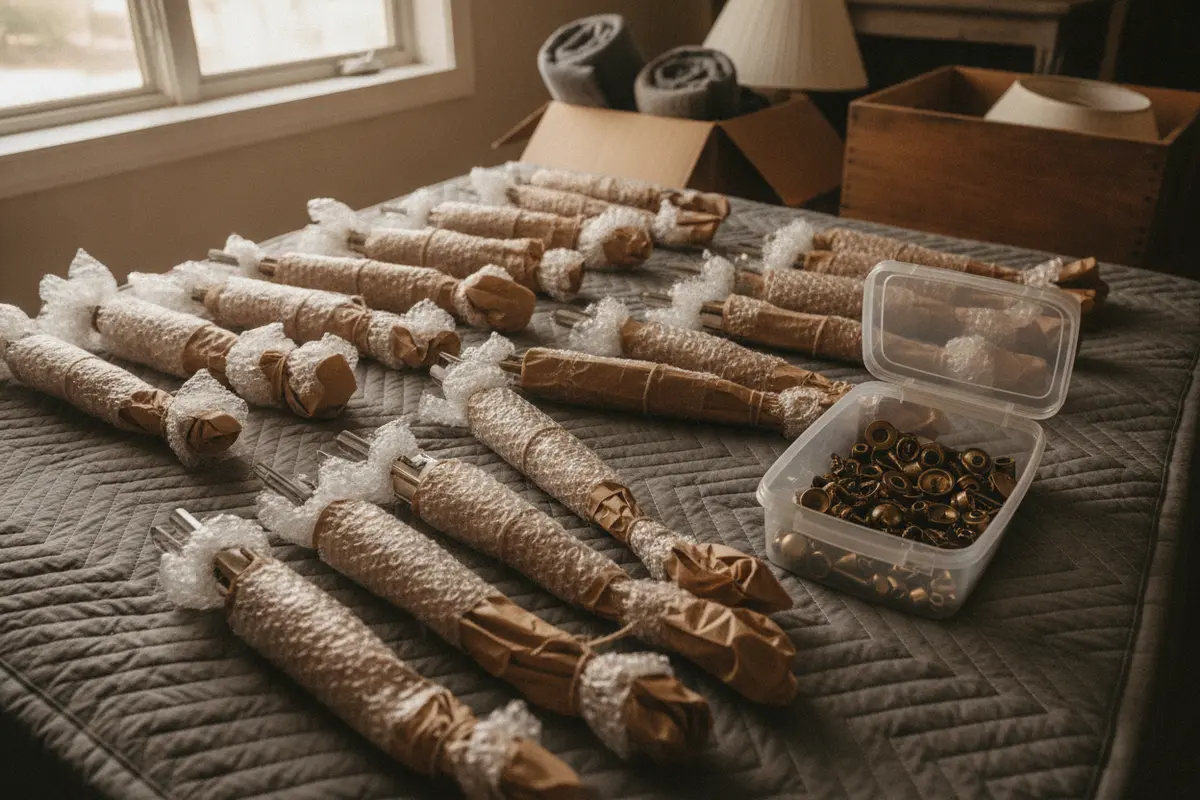
A chandelier may require more preparation than ordinary household goods. Parts that can move or touch one another may need individual protection. A packing plan should address projecting arms, loose crystals, shades and how the fixture will be prevented from shifting. The right package depends on its shape and materials, so do not assume one standard carton fits every fixture.
Ask whether the estimate includes packing labor and materials, whether the fixture should be ready before the crew arrives, and whether unpacking is included. The company offers general advice on packing books and packing a lamp, but neither is a substitute for a chandelier-specific plan. Use these as general packing information, then confirm the actual plan for the fixture in your home.
Tell the estimator about every detachable arm, shade and loose crystal. Keep a component list and take photographs as preparation proceeds. Avoid adhesive on finished surfaces. If you do not know how a piece separates, ask before attempting to remove it. Delaware Moving & Storage describes its approach to packing with care; ask how that applies to this item.
A practical packing discussion can cover several separate questions: will the fixture travel assembled or in parts; who removes and protects the parts; how are fragile pieces separated; what container will be used; and who verifies the component count at delivery? Write down the answers. If the packing plan changes because the fixture’s condition or construction differs from what was described, ask how the estimate and responsibility change before the work proceeds.
How do access and route affect the work?
Even a well-protected fixture can be awkward to carry through a tight space. Check door widths, turns, stair landings, elevator dimensions and ceiling clearance along the path from the room to the truck. Repeat the check at the destination; the two homes may present different constraints. Photos of the narrowest points can help an estimator understand the route.
Be precise about what a measurement represents. A doorway width is not the same as the width of a turn just beyond it. Note low ceiling fixtures along the carrying path, stair railings, tight landings or elevator doors that may limit the angle at which an item can be carried. Do not move furniture or remove building fixtures without permission; instead, flag a possible obstruction and ask what preparation is expected.
For local moves around Wilmington, Newark, Middletown, Hockessin, New Castle, Bear and Townsend, access and time at each home can be relevant. The company also serves parts of nearby Pennsylvania and Maryland; confirm the two addresses and availability when requesting an estimate. Lancaster-area availability should be confirmed rather than assumed. See the service area information.
For an interstate move, provide the full route and ask how the chandelier will be listed in the shipment. Delaware Moving & Storage has been an official Wheaton World Wide Moving agent since 1999. Its interstate moving guide can help you plan the broader move. For general federal information about interstate household-goods moves, consult the Federal Motor Carrier Safety Administration and its consumer resources; use the agency’s current information to check which rules and tools apply to your move.
How should you coordinate the move-day sequence?
Set out the order of the work before the move date. Confirm when the electrician will disconnect the fixture, when it must be ready for the crew and who will pack and label the parts. If the crew is packing it, ask what preparation is expected. If you pack it, confirm what packaging and inspection arrangements the mover requires.
At the destination, identify a clean place for the packed chandelier to remain while you check it. Keep it away from walkways, doors and stacked items. Coordinate with the installer, but leave time for an inspection before electrical work begins. Write down who has each component and who is responsible for the next handoff. If a delivery time or access detail changes, share it with the relevant providers promptly rather than relying on a message passed through someone else.
A useful schedule might read: electrician disconnects on the agreed date; component inventory and photographs are checked; mover handles the item under the written plan; recipient inspects it after delivery; electrician installs only after inspection. The exact sequence depends on the providers and household schedule, but naming each handoff avoids relying on assumptions. The company’s move-day preparation steps can help coordinate the larger household schedule.
For example, if the electrician can only come on the morning of pickup, first confirm whether the mover can accommodate that readiness time. If the fixture must be packed before the crew arrives, make that clear in advance. If it is still installed when the crew arrives, do not expect the crew to resolve the electrical work unless that service has been explicitly agreed. A small schedule check can prevent an avoidable delay or a change in scope.
What should you compare in a quote?
Compare the written scope, not just a bottom-line amount. Proposals may cover different tasks. Ask what each item-specific charge means, whether the survey included the fixture, and what would cause the plan or estimate to change. A lower amount may reflect fewer included services; a detailed proposal makes the difference visible.
| Situation | Questions to ask | Budget or planning issue |
|---|---|---|
| Fixture is disconnected and ready | Who packs it, what protection is needed, and does the scope include loading and transport? | The crew may handle a prepared item rather than arrange disconnection or packing. |
| Fixture remains installed | Who disconnects it, and when must it be ready? | Electrical work is separate unless explicitly confirmed. |
| Many fragile or detachable pieces | Will components be inventoried and wrapped separately? What materials are included? | Preparation and materials may differ from a simple fixture. |
| Large fixture or difficult access | Did the survey include dimensions, stairs, turns and elevator? | Handling time and carrying plan depend on the route through each home. |
| Long-distance shipment | How is the item described and packed in the shipment? | Weight, mileage and shipment scope inform long-distance pricing. |
| Storage between homes | How will the fixture be identified, protected and included in the storage plan? | An extra stage may affect packaging, inventory and handling. |
Ask for a written list of included labor, materials, access-related work and excluded tasks. Confirm whether the estimate assumes the chandelier is already disconnected, and what happens if its condition or component list changes. Delaware Moving & Storage uses physical or virtual surveys to prepare detailed estimates. Its in-home estimate information explains one way to begin that conversation.
To compare two proposals, put the answers side by side: survey method, fixture description, packing responsibility, materials, loading and transport, storage if needed, excluded electrical work, and what happens if access or condition differs. If one provider has assumed the item is ready and another has included packing, the amounts do not represent the same service. Ask each provider to clarify its assumptions before choosing.
Also ask how the fixture appears in the moving documents and what valuation protection options, terms and limits apply. Do not assume that purchase price or sentimental value automatically determines the protection available. Keep relevant records and make sure the estimate and move documents describe the fixture accurately. If you need to raise a concern after delivery, understand the provider’s process and keep photographs and inventory records with your move paperwork.
How should you document the fixture before it travels?
Take clear photographs in good light before packing. Capture the whole chandelier, close views of joints and crystals, and visible damage or previous repairs. If there is a maker’s label, model number, purchase record or original packing instruction, save it with your inventory. Keep a copy of the photos accessible during the move rather than only on a device packed away.
Create a component list that can be checked at pickup and delivery. Note removable shades, arms, crystals and hardware, and record where small fittings have been placed. If someone else packs the item, ask how the inventory will correspond to its box or container. At delivery, compare visible contents with the list before installation and photograph any concern. A simple list might identify “four glass shades,” “six detachable crystals” and “one labeled hardware packet,” if those items match your fixture.
Documentation is useful for planning as well as resolving questions. A photo can help explain an unusual shape or access challenge during the survey. A condition record can distinguish an existing chip from an issue first noticed after delivery. Keep estimates, inventory notes, receipts or available maker information together so you do not have to reconstruct the details after the move.
Can storage be part of the chandelier move?
If move-out and move-in dates do not align, mention storage when requesting an estimate. Ask whether the chandelier can be included, how it will be identified, and whether it should remain in its transport packaging. Confirm the storage arrangement rather than assuming every item or packing method is covered automatically.
Keep photographs and the component list with your move records, and ask how the fixture will be tracked through pickup, storage and delivery. Confirm whether the storage period requires any change to the packing plan, and whether access to the item will be possible if your dates change. The company’s storage information can support a discussion about how storage fits the schedule.
How can you prepare for an accurate estimate?
Make a short worksheet that separates mover labor and transport from packing, electrician work, storage and installation. You do not need to estimate each service yourself. Use the worksheet to record provider estimates and open questions, such as who disconnects the fixture and when it must be ready. Attach dimensions, route details and access photographs so each conversation starts from the same facts.
- Photograph the chandelier, attachment point and any existing damage.
- Record approximate dimensions and manufacturer information if available.
- List detachable parts and hardware without dismantling anything unfamiliar.
- Photograph narrow doors, halls, stairs and elevators at both addresses.
- Agree who disconnects and reinstalls the fixture, and coordinate the dates.
- Specify whether packing, transport, unpacking or storage is requested.
- Review the written estimate and ask about unclear fees, services, valuation and changes.
Give the same information to every mover you compare. That makes a transport-only quote easier to distinguish from one that includes packing or a more detailed survey. Delaware Moving & Storage is a family-owned, full-service relocation and storage company serving the tri-state area from northern Delaware for more than 42 years. For a broader move, its local moving information describes another part of the planning conversation.
Before you submit details, check that you have an origin and destination, a likely move date, a brief description of the chandelier, clear photographs, any known dimensions, and notes about access at each home. Mark unknown facts as unknown rather than filling gaps with guesses. That lets the estimator identify what still needs verification and helps you get a scope tailored to the actual move.
Frequently Asked Questions
Can you get a chandelier moving estimate from a photograph?
Photos help, but they may not show dimensions, weight, access or all packing needs. Send them as a starting point and ask whether more details or a physical or virtual survey is needed for a detailed estimate.
Should a mover take down and reconnect my chandelier?
Do not assume the moving crew performs electrical work. Unless the mover confirms appropriate service and qualified personnel, arrange a qualified electrician and clarify each party’s responsibility before move day.
Does the estimate include chandelier packing?
It depends on the written scope. Ask whether materials and labor are included, whether the fixture needs special preparation, and whether unpacking is part of the service. Describe detachable and fragile parts.
Can a chandelier go into storage between homes?
Ask whether it can be included and how it will be packed, listed and identified. Share the storage dates and confirm how handling is addressed through pickup, storage and delivery.
Get an estimate based on your actual fixture
The cost of moving a chandelier is easier to plan when the estimate accounts for the item, packing, access and included services. Share photographs, dimensions and route details, and arrange electrical work separately where needed.
A clear written scope gives you a practical basis for budgeting and makes each handoff easier to coordinate.